
Why Karen Read’s $1.4M Prosecution Expense Is Justified
From O.J. to Arias: Why Million-Dollar Trials Are More Common Than You Think
When Norfolk County released invoices showing that Karen Read’s second trial cost taxpayers more than $1.4 million, critics pounced. But is that number really excessive? Not when you compare it with other high-profile, expert-heavy prosecutions.
Here’s why the expense is justifiable:
High-Profile Case = High Stakes
This wasn’t just a “routine” trial. The Read case had:
National media attention
Accusations of corruption and cover-up
A community divided and protesting outside the courthouse
That means the state had to put on an airtight, bulletproof case—not just for the jury, but for the court of public opinion. Skimping on experts or presentation would have looked like incompetence (and been ammunition for the defense).
Experts Are Expensive, But Necessary
Forensic crash reconstructionists, digital analysts, medical examiners, and police-practices experts don’t come cheap. But without them:
The defense narrative (police frame-up, backyard fight, missing evidence) would dominate.
Complex technical issues (car data, iPhone activity, injuries) would be left unchallenged.
Investing in credible, top-tier experts is the only way to ensure jurors hear both sides.
Special Prosecutor Justification
Appointing Hank Brennan (and paying him accordingly) was unavoidable if the case was going to move forward. Hiring a seasoned outside prosecutor also sends a message: “This case will be handled independently and fairly.” That level of public trust costs money.
Deterrence & Public Confidence
Spending big can be framed as an investment in justice:
It signals that wealthy, high-profile defendants don’t get off easy just because trials are expensive.
It shows that the state is willing to spend what it takes to pursue accountability, even when resources are stretched.
It maintains faith in the legal system in a case where many accused the system of being rigged.
Comparative Justification
As we mentioned earlier, other high-profile trials (Nichols, Simpson, etc.) cost millions, too. Compared to those, $1.4M looks less like a boondoggle and more like par for the course when public trust, expert testimony, and outside prosecutors are all in play.
Click through the cases below to see how other high-profile prosecutions racked up millions in costs — and why Karen Read’s retrial isn’t unusual by comparison.
🎵 Phil Spector (2003–2009, CA) | Convicted
Two trials: First ended in hung jury (2007), retried (2009).
Costs: Estimates put LA County’s prosecution at $2–3 million total.
Why so high? Forensic pathologists, gunshot residue experts, crime scene reconstruction.
Outcome: Convicted in 2009, but cost still massive.
🎭 Robert Blake (2005, CA) | Acquitted
Accused of killing his wife Bonnie Bakley.
Costs: Reported to exceed $3 million for the prosecution.
Defense spent even more, calling their own army of experts.
Outcome: Acquitted, but LA taxpayers were not happy.
🎤 Snoop Dogg (1996, CA) | Acquitted
Murder trial (“Murder Was the Case”).
Costs: Contemporary reports suggested over $1 million, mainly due to expert witnesses and heavy LAPD involvement.
Outcome: Acquitted, but costs were written off as the price of trying a high-profile gang-related case.
🎶 Michael Jackson (2005, CA) | Acquitted
Child molestation trial in Santa Barbara.
Costs: Around $2.7 million for the prosecution (not counting sheriff overtime, court security, and logistics—total topped $5 million).
Outcome: Acquitted, but DA Tom Sneddon defended the cost as “worth it” to show victims that accusations would be taken seriously.
🎤 Bill Cosby (2017, PA) | Conviction, Later Overturned
Two trials: First hung jury, second conviction (later overturned).
Costs: Court filings showed prosecution expenses well into seven figures across both trials.
Key cost driver: Multiple expert witnesses (toxicology, psychology) and the sheer logistics of retrying.
Outcome: Conviction, then overturned on procedural grounds.
⚖️ O.J. Simpson (1995, CA) | Acquitted
Accused of murdering Nicole Brown Simpson and Ron Goldman.
Costs: The prosecution spent $9 million+, while Simpson’s “Dream Team” defense reportedly cost $3–6 million.
Outcome: Acquitted. The trial became a media spectacle, showing how costs skyrocket when celebrity, race, and forensic science collide.
🚔 Brian Nichols (2005, GA) | Convicted
Accused of killing a judge, court reporter, deputy, and federal agent during an escape from an Atlanta courthouse.
Costs: Combined prosecution and defense exceeded $3 million, with death penalty litigation, multiple experts, and massive security expenses.
Outcome: Convicted and sentenced to life without parole (death penalty was dropped to end the costly trial).
👶 Scott Peterson (2004, CA) | Convicted
Accused of murdering his pregnant wife Laci and their unborn son, Conner.
Costs: Estimates run $3–4 million+ for the prosecution, including forensic experts, lengthy jury sequestration, and high-profile courtroom logistics.
Outcome: Convicted, sentenced to death (later resentenced to life without parole). Currently under Innocence Project review for possible retrial.
🍼 Casey Anthony (2011, FL) | Acquitted
Accused of murdering her 2-year-old daughter, Caylee.
Costs: The trial reportedly cost $700,000–$1 million for the state, including forensic testing, expert witnesses, and weeks of jury sequestration.
Outcome: Acquitted of murder charges, convicted only of lying to law enforcement. The cost was heavily criticized given the acquittal.
🔥 Jodi Arias (2013, AZ) | Convicted
Accused of murdering her boyfriend, Travis Alexander.
Costs: Estimated $3 million+, including a mistrial in the penalty phase and retrial for sentencing. Defense experts (psychologists, domestic violence specialists) drove costs higher.
Outcome: Convicted of first-degree murder, sentenced to life without parole. The retrial of the penalty phase alone cost Arizona taxpayers over $2.5 million.
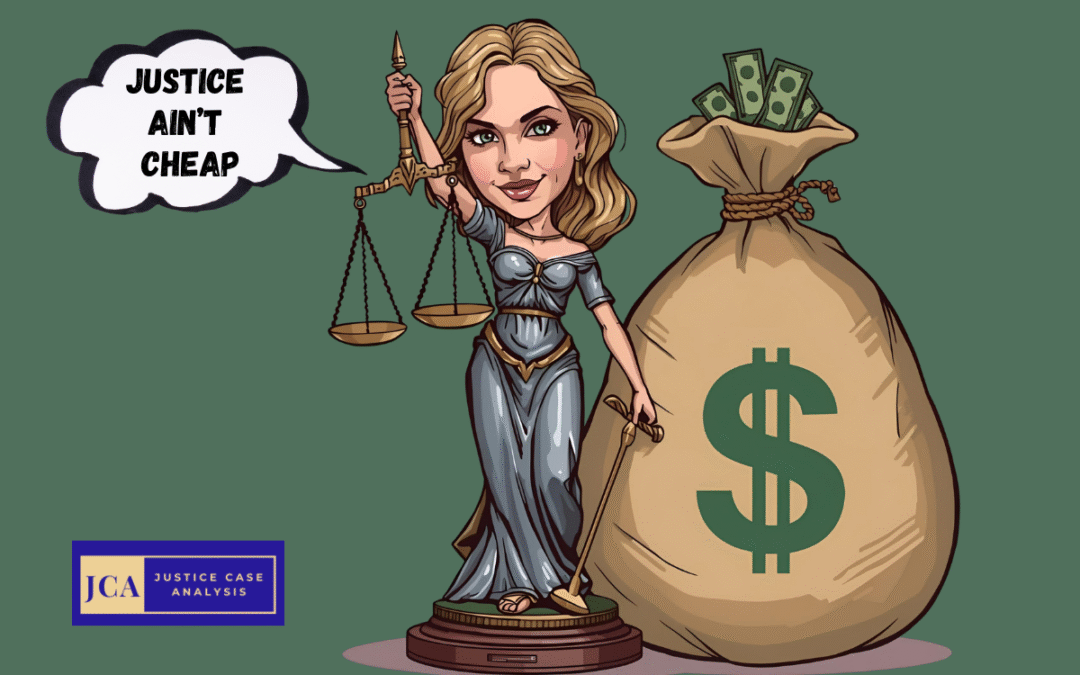
💰 Justice Isn’t Cheap
These cases show a clear pattern: once you add celebrity, capital charges, or retrials, million-dollar trials are the norm, not the exception.
Million-dollar prosecutions are NOT unusual in high-profile, expert-heavy cases.
Even when the state loses (Blake, Jackson, Snoop, Cosby overturned), prosecutors argue the expense was justified:
To give alleged victims a voice.
To uphold rule of law regardless of celebrity status.
To show impartiality (money shouldn’t determine if a case goes forward).
Karen Read’s $1.4M retrial cost actually looks modest compared to these headline-making cases.
If California and Pennsylvania could justify spending $3–5 million on celebrities who walked, Massachusetts can justify $1.4M on a case with a dead Boston police officer, forensic disputes, and national scrutiny.
✨ In short:
The prosecution can argue that the cost wasn’t just for this case, but to preserve the credibility of the justice system itself. If they had cut corners and lost, the narrative would’ve been, “They didn’t even try.”
Related Articles
Lindsay Clancy Mistrial – Jurors Speak Out
PLYMOUTH, Mass. – Five jurors have now explained their reasoning after the mistrial. Their interviews reveal how they viewed the evidence, the experts, Lindsay Clancy—and the lone juror who refused to agree. The Lindsay Clancy murder trial ended without a verdict. But...
Celeste Rivas Hernandez Family Sues d4vd: What the 20-Page Lawsuit Actually Alleges
LOS ANGELES - The family of Celeste Rivas Hernandez has opened a second legal front against singer David Anthony Burke, better known as D4vd. Celeste's parents, Mercedes Martinez and Jesus Edgardo Rivas Alvarado, have filed a sweeping 20-page civil complaint in Los...
Former Bryan Kohberger Defense Witness Sy Ray Traded the Courtroom for a Book Tour
The true-crime community is currently processing a massive ethical whiplash. Sy Ray, the prominent digital forensics expert originally hired by public defender Anne Taylor to save Bryan Kohberger from the death penalty, has completely switched sides. Bryan Kohberger...