
Bryan Kohberger Wants His Guilty Plea Back: What Do the Court Records Actually Show?
New Post-Conviction Relief filings raise questions about the guilty plea—but the most revealing evidence may be found in the court record created before it.
The Guilty Plea Halted the Trial. It Didn't Halt the Questions.
Coeur d’Alene, Idaho. – Bryan Kohberger is asking an Idaho court in a Post Conviction Relief filing to withdraw the guilty plea that sent him to prison for life, alleging ineffective assistance of counsel, coercion, false promises, and the withholding of potentially exculpatory evidence.
To understand whether the new claims have support, it is necessary to look backward. Just days before Kohberger pleaded guilty, his lead defense attorney, Anne Taylor, told the court that the defense was not prepared for trial, had not reviewed all of the discovery and still had investigative work to complete.
Judge Steven Hippler rejected those arguments. Six days later, Kohberger pleaded guilty.
Now, more than a year later, the circumstances surrounding that abrupt decision are at the center of a new legal battle.
The Timing of Bryan Kohberger's Guilty Plea is Striking
Let’s take a look at the timeline to better understand how things went down:
June 18, 2025: Anne Taylor Tells the Court the Defense Is Not Ready
Less than three weeks before the trial was scheduled to begin, Kohberger’s defense team asked Judge Hippler for a continuance. Lead attorney Anne Taylor did not characterize the request as a matter of convenience. She argued that additional time was necessary to protect Kohberger’s constitutional rights—including his rights to due process, a fair trial, effective assistance of counsel, confrontation, a full defense and, if convicted, a constitutionally adequate capital sentencing proceeding.
Taylor told the court that the defense had received approximately 68 terabytes of discovery, had made 23 requests for additional discovery, and had filed seven motions to compel during the case. Then she made a statement that has taken on considerably greater significance in light of Kohberger’s current post-conviction claims:
“The record is replete with notice that we are not prepared to go to trial in this case.”
Taylor continued:
“The discovery is vast and we have not had a chance to review it all.”
She said discovery was still arriving that very week and acknowledged that she had not yet reviewed it. This wasn’t the only unfinished work identified by the defense. Taylor told the court that records still needed to be collected, collateral interviews remained incomplete, and certain investigative “red flags” required further work. She argued that those issues might affect the opinions of existing experts or reveal a need for additional experts.
Later in the hearing, Taylor returned to the point:
“There is still a lot left to do. There is still a lot left that is not known.”
And she explicitly connected that unfinished investigation with the constitutional problem she believed the defense faced:
“That’s where there’s ineffective assistance of counsel. That’s where there’s not a fair trial.”
She asked Hippler to postpone the trial. He didn’t.
The State Saw a Very Different Defense Team
Prosecutors strongly disputed Taylor’s contention that the defense needed additional time. The State pointed to an enormous defense operation already assembled around Kohberger: attorneys, investigators, a mitigation specialist, retained experts, dozens of proposed mitigation witnesses and more than 130 proposed penalty-phase exhibits.
Prosecutor Joshua Hurwit argued that effective representation did not require a “scorch the earth” investigation of every conceivable lead. He also challenged the timing.
According to the State, the defense had previously relied upon the existing trial date when opposing additional time sought by prosecutors. Hurwit suggested that after efforts to use the volume of discovery as grounds to remove the death penalty failed, the defense had shifted to seeking a continuance. In other words, the State’s position was essentially this: The defense may have wanted more time. That did not mean it constitutionally needed more time.
That distinction would become central to Hippler’s ruling.
June 26: Judge Hippler Rejects the Defense’s Argument
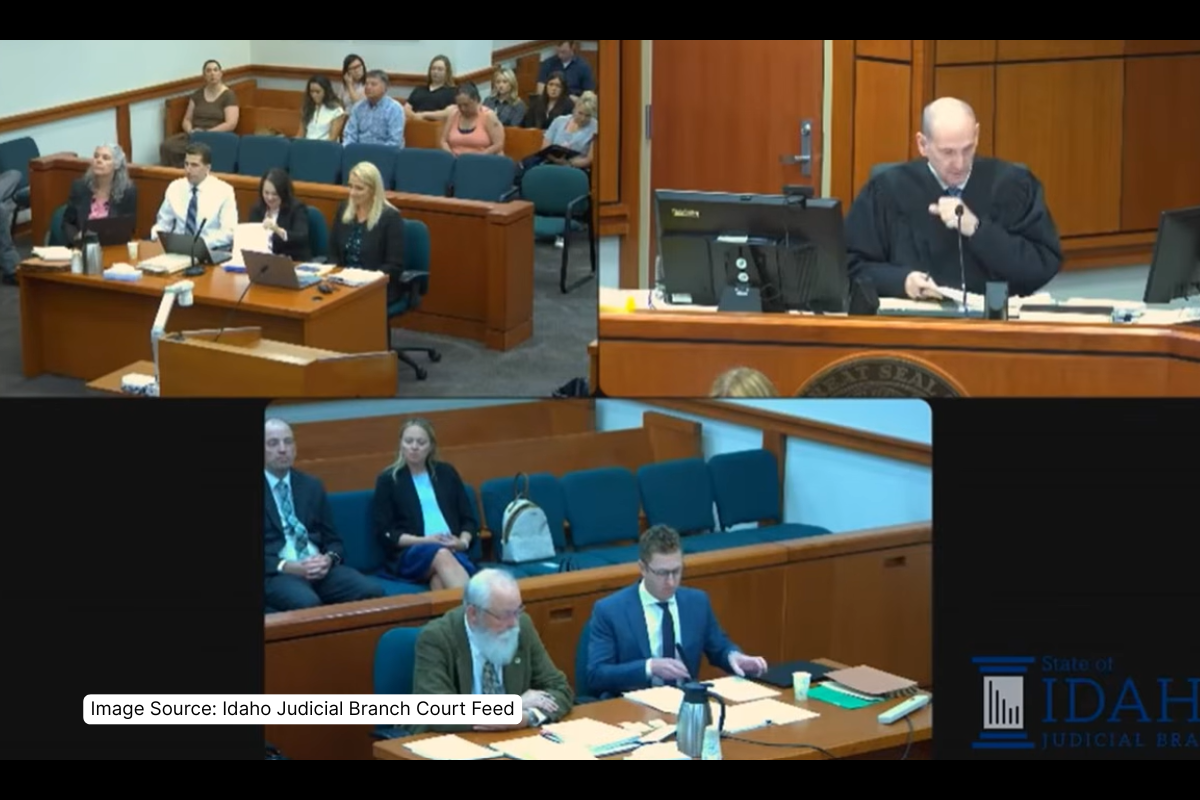 Eight days after the hearing, Judge Hippler issued a 19-page decision denying the continuance. And it was not a close call in his written analysis. Hippler found that Kohberger had failed to demonstrate good cause for postponing the trial or that his substantial rights would be prejudiced if the case proceeded as scheduled. The judge was particularly skeptical of the defense’s complaints about unreviewed discovery.
According to Hippler, the defense had again failed to identify specific relevant evidence that remained unreviewed. He noted that counsel had “robustly litigated” the case, retained approximately two dozen experts, assembled a full mitigation team, and disclosed extensive witness and exhibit lists.
Hippler concluded that those actions undermined the defense’s claims that it could not adequately prepare for trial. He went further, characterizing the discovery argument as an eleventh-hour tactic aimed at delay rather than a demonstrated threat to Kohberger’s constitutional rights.
The judge was similarly unconvinced that the mitigation investigation justified postponement. The record showed that the defense had investigated Kohberger’s educational history from kindergarten through his doctoral studies, medical and mental-health history, employment, family history and records extending across multiple generations.
Investigators had interviewed Kohberger and immediate family members, extended relatives, former teachers, a boxing coach, a psychologist who evaluated him years earlier, a university professor and advisor, a former coworker and others. The team had also reviewed family correspondence and jail calls.
From Hippler’s perspective, this was not the record of an abandoned or constitutionally inadequate defense investigation. The court therefore denied the continuance.
And six days later, Bryan Kohberger pleaded guilty.
Six Days Later, the Case Was Over
That six-day period deserves attention. It does not prove that Kohberger was coerced. It does not prove that Anne Taylor or anyone else provided ineffective assistance. And it certainly does not prove Kohberger is innocent. But it establishes important context that existed long before Kohberger filed his post-conviction petition.
On June 18, 2025 his lead attorney told the court that the defense was not prepared for trial and that significant work remained.
On June 26, 2025 Hippler rejected that argument and ordered the case forward.
On July 2, 2025 Kohberger abandoned his not-guilty plea and accepted a resolution that eliminated the possibility of execution but guaranteed that he would spend the rest of his life in prison.
Now Kohberger says what happened during that period was not what it appeared to be.
July 2026: Kohberger Says His Guilty Plea Wasn't Voluntary
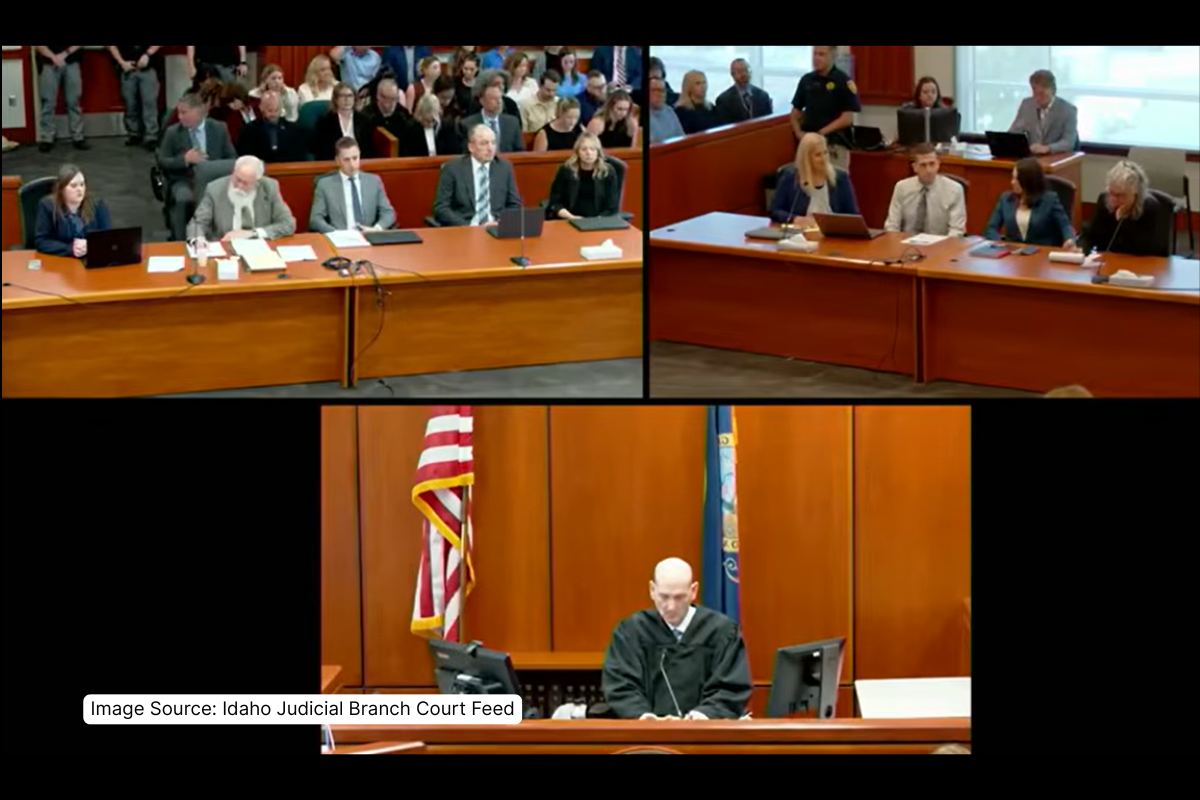 Kohberger initially filed his petition for post-conviction relief himself. The handwritten document is relatively short, but the allegations are remarkably specific.
He lists three primary grounds for relief:
– ineffective assistance of counsel during the criminal proceedings
– a plea that was not knowingly or voluntarily entered because it was induced by “unkept promises”
– a plea that was not voluntarily entered because of alleged threats by his legal counsel
When asked what his attorneys failed to do, Kohberger identifies several additional allegations. One stands out.
The Hair Found in Ethan Chapin’s Hands
Kohberger alleges that his attorneys failed to disclose or review with him potentially exculpatory evidence during plea discussions—specifically, what he describes as “clumps of unknown hair in Chapin’s hand.”
In the accompanying affidavit, he again identifies “clumps of unknown hair found in Ethan Chapin’s hands” and alleges counsel failed to conduct further inquiry into that evidence. This is one of the most important claims in the petition because it is not merely an opinion about his attorneys’ performance. It is a factual allegation that should be capable of being tested.
When did investigators discover the hair?
What testing was performed?
When was that information provided to the defense?
When did Kohberger’s attorneys learn about it?
What did they know about its potential significance?
Most importantly for this PCR claim: Did Kohberger know about it before he agreed to plead guilty?
The petition itself does not answer those questions. Nor does the existence of unidentified hair automatically make it exculpatory. Its evidentiary significance would depend upon where it was recovered, its characteristics, testing results, contamination or transfer possibilities and the surrounding evidence.
But Kohberger has now put the issue directly before the court.
“Actual Guilt” and the Threat of Death
Kohberger makes another striking allegation. He claims his attorneys convinced him that actual guilt was not an important factor in deciding whether to accept the plea because the death penalty was imminent.
In his affidavit, he describes himself as having been persuaded to “falsely confess” to capital murder and felony burglary through coercion, disinformation, false promises, and the withholding of exculpatory discovery.
There is nothing inherently improper about a capital defense attorney discussing the very real possibility that a client could be convicted and sentenced to death. Evaluating that risk is an essential part of advising a client considering a plea agreement.
The legal question becomes very different if Kohberger can establish that attorneys materially misrepresented evidence, withheld information necessary for an informed decision, made promises they could not fulfill, or improperly coerced the plea.
Those are the facts that now need to be developed.
Alleged Promises About Life Without Parole
Kohberger also claims his attorneys made representations about what a life-without-parole sentence would actually entail. His handwritten petition references alleged promises concerning immediate contact visits, freedom of movement and employment, among other conditions, and his affidavit describes alleged misrepresentations concerning life on death row and what would happen after the plea.
These allegations should also be verifiable.
What exactly was Kohberger told?
Who told him?
Were statements framed as guarantees, expectations or possibilities?
Were representations based upon information from the Idaho Department of Correction?
And did any alleged misinformation materially affect Kohberger’s decision to plead guilty?
At this point, the petition gives us Kohberger’s version. It does not establish the answer.
Kohberger's Claims Also Put His Former Attorneys in an Uncomfortable Position
Kohberger’s petition does more than challenge the legal advice he received. Some of his allegations directly challenge the conduct of his former defense attorneys.
He alleges that counsel failed to disclose potentially exculpatory evidence during plea discussions, made false promises about the consequences of a life-without-parole sentence, used threats or coercion to obtain his plea, and insisted that the plea “need not be truthful” despite what Kohberger describes as his “vehement denial of actual guilt.” In his accompanying affidavit, he alleges that he was convinced to “falsely confess” to the murders.
Those allegations have not been proven, and the petition does not necessarily identify which member of Kohberger’s defense team allegedly made each statement. But by raising them, Kohberger has placed his former attorneys’ advice and conduct at the center of the post-conviction case.
That could put Anne Taylor and other members of the former defense team in an unusual position. To defend their representation, they may eventually need to explain what Kohberger was told, what evidence had been reviewed, what remained outstanding, and what occurred during the plea negotiations. The timing makes those questions particularly significant.
On June 18, she unequivocally told Hippler:
“The record is replete with notice that we are not prepared to go to trial in this case.”
She also said the defense had not reviewed all the discovery, that substantial work remained, and that “there is still a lot left that is not known.”
On July 2, 2025, Hippler asked:
“Have you been able to do all the discovery you feel necessary?”
“Yes, Your Honor,” Taylor responded.
Any statements Taylor made during the plea proceedings concerning the defense team’s preparation should therefore be examined alongside her June 18 representations. An apparent inconsistency would not, standing alone, establish that Taylor misled the court. Trial readiness and having sufficient information to advise a client about a plea are not necessarily the same thing.
If Kohberger’s attorneys had enough information to competently advise him to plead guilty, the question becomes what they knew and what they communicated to him. If important evidence remained unreviewed or undisclosed to Kohberger, the question becomes whether that information could reasonably have affected his decision.
And if Kohberger was telling his attorneys that he was innocent while simultaneously preparing to admit guilt in open court, the circumstances surrounding those conversations could become some of the most consequential evidence in the entire post-conviction proceeding.
By making these allegations, Kohberger has placed aspects of his former attorneys’ advice and conduct directly at issue. Communications that ordinarily would be protected by attorney-client privilege may therefore become subject to disclosure to the extent necessary for the State and the court to evaluate his ineffective-assistance claims. That could eventually require Taylor and other members of the former defense team to explain what evidence had been reviewed, what Kohberger was told, what advice he received and what occurred during the plea negotiations.
The Problem for Kohberger: The Plea Record
Kohberger faces an obvious obstacle. He didn’t simply sign a piece of paper behind closed doors. He entered guilty pleas in court.
That proceeding created a record designed specifically to establish that a defendant understands the rights he is surrendering and is making the decision knowingly and voluntarily. That means Kohberger’s current allegations eventually have to be measured against what he told Judge Hippler when the pleas were entered.
If Kohberger represented under oath that no one threatened him, no undisclosed promises induced the plea, he understood the consequences, and he was satisfied with his attorneys, those statements will be significant evidence against his present claims.
But they are not necessarily the end of the inquiry if he can produce evidence that materially undermines the reliability of those representations. That is why the communications surrounding the plea may become so important.
Ineffective-Assistance Claims May Open a Door Kohberger Previously Kept Closed
By accusing his former attorneys of ineffective assistance, Kohberger has placed aspects of his communications with them directly at issue. That creates an unusual consequence. Communications that ordinarily would be protected by attorney-client privilege may become subject to disclosure to the extent necessary for the State and court to evaluate the allegations Kohberger himself has made.
That could ultimately provide answers to questions the public has been asking since the abrupt guilty plea:
What was happening inside the defense team?
What evidence was being discussed with Kohberger?
What advice was he receiving?
Why did a defendant whose attorneys had spent more than two years preparing to proclaim his innocence suddenly decide not to go to trial?
And perhaps most importantly:
What happened between June 26 and July 2?
What the Existing Record Supports
At this stage, the records support some parts of Kohberger’s broader narrative much more strongly than others.
They support that his defense team told the court it was not ready for trial. They support that Taylor said discovery remained unreviewed and the investigation remained unfinished.
They support that Taylor herself warned that forcing the case forward under those circumstances implicated effective assistance of counsel and Kohberger’s right to a fair trial.
But the record also supports the other side.
Hippler examined those complaints before the plea and found them insufficient. He concluded that the defense had conducted an extensive investigation, failed to identify significant relevant discovery that remained unreviewed, and had not shown that proceeding to trial would prejudice Kohberger’s substantial rights.
And that’s the tension at the heart of the current litigation.
What the Record Does NOT Yet Establish
The records reviewed so far do not establish that Kohberger is actually innocent. They do not establish:
that Anne Taylor or another attorney deliberately withheld the hair evidence from him.
that defense counsel lied to him.
that he was threatened or coerced into pleading guilty.
that alleged promises about prison conditions were made—or that any such representations caused him to plead guilty.
And the fact that Taylor said the defense needed more time does not, by itself, establish ineffective assistance of counsel. Those are questions requiring evidence. But there is an equally important conclusion on the other side:
The existing record does not allow Kohberger’s allegations to be dismissed merely because he made them after pleading guilty.
Some of the circumstances he now relies upon existed in the court record before the plea.
A Very Different Bryan Kohberger Emerges
Shockingly, Bryan Kohberger’s silence, after four years, has finally broken. He has since gone considerably further than asking a court to examine his former attorneys’ conduct.
In a statement dated July 26, 2026, he declared his intention to enter a not-guilty plea if his existing convictions are overturned and said he welcomes the State having another opportunity to seek the death penalty.
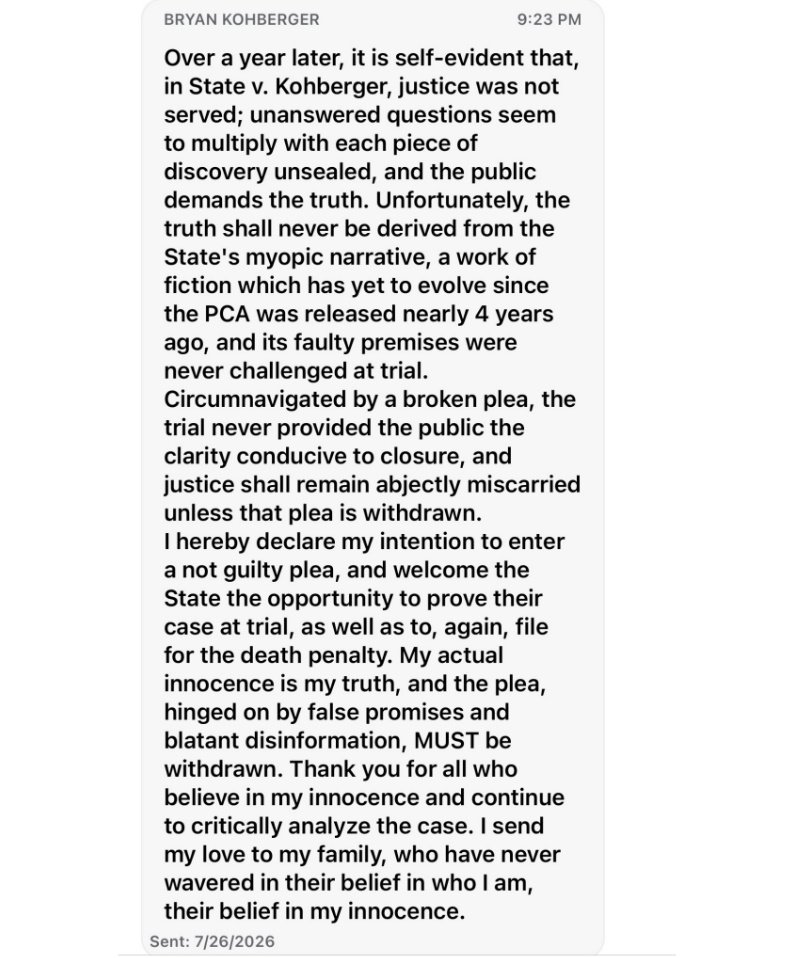
He proclaimed: “My actual innocence is my truth.”
He characterized the previous plea as “broken” and attributed it to false promises and disinformation.
The statement is provocative. It is not evidence of innocence.
A defendant’s willingness to risk execution may affect how the public perceives his conviction, but it does not establish whether he committed the crimes.
The evidence still has to do that work.
So What Happens Now?
The post-conviction case is no longer simply about whether Bryan Kohberger regrets pleading guilty. His claims have put the conduct of his former defense team, the advice surrounding the plea and potentially privileged communications directly into dispute.
His new attorneys, Greg Rauch and Jason Goldman, now attempt to develop those claims while the State fights to preserve convictions obtained through Kohberger’s own guilty pleas.
And Judge Hippler occupies an unusual position in the middle of it. He is the judge who rejected Taylor’s contention that the defense needed more time. He presided over Kohberger’s guilty plea. He sentenced him.
And unless the pending motion to disqualify succeeds, he may also be asked to evaluate allegations that the circumstances surrounding that plea rendered it constitutionally invalid.
A hearing on the motion to disqualify is scheduled for October 15, 2026 at 1:30 p.m.
There is much that remains unknown. But one question has become increasingly difficult to avoid.
What happened during those six days?
On June 26, 2025… Judge Hippler rejected Anne Taylor’s argument that the defense was not ready and ordered the capital murder case toward trial.
Six days later… Bryan Kohberger pleaded guilty.
A year later… he says that decision was the product of coercion, misinformation, false promises, and ineffective assistance of counsel.
Whether he can prove any of that remains to be seen. But this time, unlike the original criminal case, the events surrounding the plea itself may finally be litigated.
Related Articles
Former Bryan Kohberger Defense Witness Sy Ray Traded the Courtroom for a Book Tour
The true-crime community is currently processing a massive ethical whiplash. Sy Ray, the prominent digital forensics expert originally hired by public defender Anne Taylor to save Bryan Kohberger from the death penalty, has completely switched sides. Bryan Kohberger...
Investigators Debunk Myths in Bryan Kohberger Case
Image Credit: (Pool/Getty Images) In a rare and revealing post-sentencing interview with CNN’s Jean Casarez, Idaho State Police Lt. Darren Gilbertson and Moscow Police Chief Anthony Dahlinger addressed the public directly, cutting through a sea of misinformation and...
Will Bryan Kohberger Speak at Sentencing?
Image Credit: (Pool/Getty Images) Update: 7/23/2025 As Predicted, Bryan Kohberger did not make an allocution at his sentencing hearing. Judge Hipler: "Mr. Kohberger, uh, you have an opportunity to make a statement if you wish to. I take it you are declining". Bryan...