
What the Defense Says Really Happened the Night Officer John O’Keefe Died
🧩 The Big Picture: “There Was No Collision”
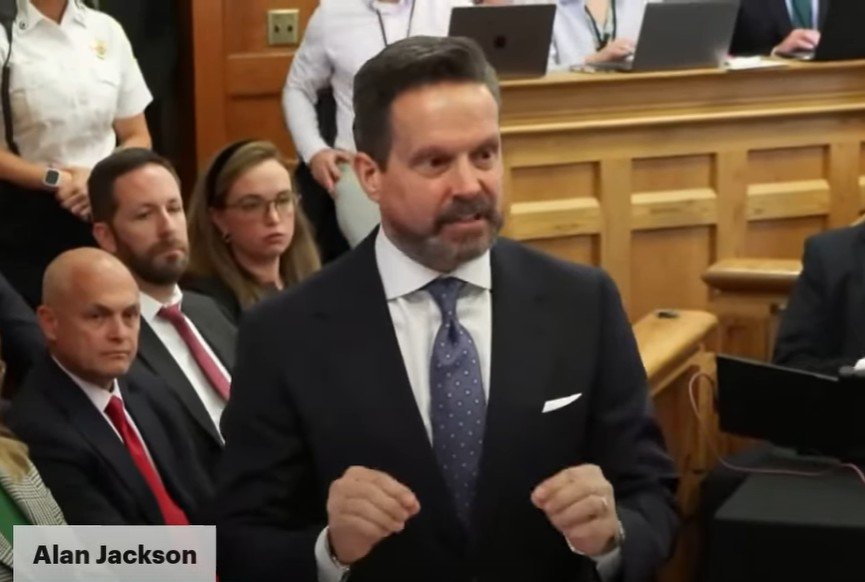
In a striking and emotionally charged opening, defense attorney Alan Jackson delivered a bold thesis to the jury:
“John O’Keefe did not die from being hit by a vehicle. Period.”
Jackson repeated this line like a mantra, arguing that science, data, and expert testimony will all prove that there was no car accident—specifically, that Karen Read’s SUV never struck O’Keefe.
Instead, the defense is painting a picture of a botched, biased, and possibly corrupt investigation, rooted in loyalty to a powerful local family and police ties rather than a pursuit of the truth.
👮♂️ Who Is Michael Proctor, and Why Does He Matter?
The defense put the spotlight on Michael Proctor, the now-fired lead investigator with the Massachusetts State Police. According to Jackson, Proctor:
-
Was a close family friend of the Alberts (the homeowners where O’Keefe’s body was found).
-
Failed basic investigative procedures, never entering the house or preserving evidence.
-
Sent a text early in the case stating:
“Is the homeowner going to catch any [__]?”
“Nope. He’s a Boston cop too.”
Proctor is described as the “cancer” at the core of the investigation, whose misconduct—according to the defense—tainted the entire case.
🧬 The Science: No Signs of a Collision
According to the defense’s expert, Dr. Elizabeth Laposata, a forensic pathologist and professor:
-
O’Keefe’s head injury was immediately incapacitating, meaning he couldn’t call or move.
-
His body had no signs of hypothermia, debunking the state’s theory he froze to death.
-
His abrasions were consistent with a dog attack, not a tail light injury.
-
He suffered no bruises, no fractures, no internal injuries—nothing consistent with being hit by a car.
“John O’Keefe did not suffer a single injury consistent with a car accident.”
🐾 A Dog, a Rehomed Pet, and a Missing Piece of the Puzzle
One of the defense’s more dramatic revelations:
Brian Albert owned a large dog—described as “not good with strangers.” O’Keefe, having never been to the house before, would have been a stranger.
Soon after the incident, the dog was “rehomed.”
Coincidence? The defense says absolutely not.
🚙 The Mysterious Ford Edge at 3:30 AM
A snowplow driver saw no body at 2:30 a.m. but reported a Ford Edge parked near the spot where O’Keefe’s body was found at 3:30 a.m.
-
No one saw the body earlier—not partygoers, not drivers, not even the plow driver.
-
Multiple Albert family members owned Ford Edges.
The defense argues this proves O’Keefe’s body was moved to the lawn, and that someone else was involved.
📱 The 2:27 AM Google Search That Changes Everything
Jennifer McCabe, a family member at the Albert house, searched:
“hos long to die in cold”
(misspelled “how,” but timestamped at 2:27 a.m.)
This was hours before O’Keefe was “discovered.” That search was later deleted, according to phone forensics.
Also:
-
Brian Higgins (another cop and Karen’s alleged admirer) made a late-night stop at the Canton PD.
-
Higgins and Brian Albert made a 2:22 a.m. phone call—then denied it.
-
Both destroyed their phones shortly after the incident.
🧊 The Tail Light Theory: Shattered or Shaky?
The prosecution’s theory hinges on a broken tail light from Karen’s SUV. But the defense says:
-
The SUV was lightly damaged at 5:07 a.m., when Karen backed into another car while panicking and looking for John.
-
Video surveillance shows this damage occurred hours after John entered the house.
-
The SUV had no signs of hitting a pedestrian, and neither did John’s injuries.
❌ “I Hit Him” – Or Did She?
The defense hammered home that Karen never confessed to hitting O’Keefe.
“She said, ‘Could I have hit him?’ Not, ‘I hit him.’”
None of the first responders on scene documented a confession. The first and only person to claim she said it was an EMT—a personal friend of the Albert family.
🕳️ A Case Full of Reasonable Doubt
The defense says this case is riddled with inconsistencies, cover-ups, and questionable police conduct:
-
The medical examiner wouldn’t call the death a homicide.
-
Investigators failed to document, preserve, or pursue key evidence.
-
And perhaps most damning: Nearly all evidence tying Karen Reed to the crime came only after Proctor had unsupervised access to her SUV.
🎤 Final Words: “Not Guilty, Not Guilty, Not Guilty”
Jackson ended with a clear ask to the jury:
“This is the literal definition of reasonable doubt.
Return the only verdict consistent with truth and justice:
Not guilty. Not guilty. Not guilty.”
📌 Takeaway:
The Defense is not just claiming Karen Reed didn’t do it.
They’re arguing she’s the scapegoat in a cover-up—one that protected cops, ignored evidence, and buried the truth.
Want the Prosecution’s version?
👉 Click here to read their opening statement summary (Link placeholder)