
The Case Against Lindsay Clancy: Charges, Evidence, and the Defense Narrative
From digital timelines to toxicology reports, a closer look at the facts prosecutors rely on—and the mental health defense challenging them.
The Charges
Following her indictment in September 2023, Lindsay Clancy was formally arraigned on October 26, 2023, in Plymouth County Superior Court. She entered pleas of not guilty to all charges.
The indictment includes:
Three Counts of Murder
Cora Clancy (age 5)
Dawson Clancy (age 3)
Callan Clancy (age 8 months)
Each charge alleges that Clancy assaulted and beat each child with intent to murder and did kill them.
Three Counts of Strangulation or Suffocation; One count for each child
These charges reflect the alleged method of killing—ligature strangulation, which prosecutors describe as prolonged and deliberate.
This isn’t just a homicide case—it’s structured to support first-degree murder theories, including deliberate premeditation and extreme atrocity or cruelty.
The strangulation charges are especially important. Prosecutors are signaling that this was not instantaneous, but rather required sustained force and time—something they will argue shows intent, awareness, and opportunity to stop.
From the very start, the legal battle is clearly defined. The prosecution must prove Clancy intentionally killed her children with the mental capacity to be held criminally responsible. The defense is expected to argue lack of criminal responsibility (insanity)—not that she didn’t do it, but that she was not legally responsible when she did. That distinction is everything.
The Evidence
At arraignment, prosecutors outlined a theory of planning, awareness, and deliberate action—supported by digital data, physical evidence, medical findings, and Clancy’s own writings.
1. A Narrow, Calculated Window of Time
Prosecutors emphasized that Lindsay Clancy created a specific window of opportunity:
She asked her husband to pick up takeout and medication.
She checked Apple Maps to estimate how long he would be gone.
He left at 5:15 PM and returned at 6:09 PM—a 54-minute window.
According to the Commonwealth, this wasn’t random—it was engineered time to carry out the killings.
2. Digital Evidence: Movement and Timing
Clancy’s fitness tracker data became a key piece of evidence.
Immediately after a phone call with her husband around 5:34 PM, her device recorded her climbing three flights of stairs in the home.
Prosecutors argue this shows that she moved deliberately between floors, she remained upstairs afterward, consistent with their theory that the children were killed in the basement, she then returned upstairs.
3. Behavior During the Crime Window
One of the prosecution’s strongest points is how she functioned during this time.
Clancy answered her husband’s call calmly.
She discussed medication and errands normally.
Had earlier ordered food, called the restaurant, provided correct details (name, number, order).
Prosecutors emphasized she showed no confusion, disorganization, or distress—arguing this reflects clear thinking and awareness.
4. The Crime Scene and Method
The children were killed by ligature strangulation. Key forensic points are the following.
Strangulation requires:
10+ pounds of pressure
Sustained force even after unconsciousness
It can take 10 seconds to a minute to render unconscious
Additional 4-5 minutes of continued pressure to cause death
Prosecutors argued that this was not instantaneous effort. She had time and multiple opportunities to stop.
The injuries suggested prolonged force, particularly in Dawson’s case. This supports their claim of extreme atrocity and cruelty.
5. Post-Crime Actions
After the killings, prosecutors allege Clancy returned upstairs and inflicted superficial cuts to her wrists and neck. She then took an overdose of medication, and exited through a window.
Notably blood evidence suggested she lowered herself out, rather than jumping. There was blood on the window sills suggesting she slid down, then on the window sills below suggesting she tried to grab them on the way down.
Injuries were described as non-lethal and limited. The prosecution argues this reflects staging or controlled behavior, not a chaotic suicide attempt.
6. Journals and Writings
Clancy’s own writings play a major role. According to prosecutors, Clancy’s journal entries were clear, organized, and detailed, included medication tracking and daily functioning.
There was no evidence in her writings of delusions, hallucinations, disordered thinking.
She wrote about postpartum anxiety, not psychosis;
She wrote about suicidal thoughts in December, but later denied them.A note stated that she felt she “resent[ed]” her other children at times, and she struggled to feel connection with them.
Prosecutors use this to argue that she was self-aware, and that she understood her thoughts and environment.
7. Internet Search
Just days before the killings, Clancy searched: “Can you treat a sociopath”
Another search was done leading up to the crime: “Ways to kill”.
The prosecution suggests this reflects disturbing preoccupation and insight into her own state of mind.
8. Toxicology: A Critical Piece
This is one of the most important—and most debated—elements.
Clancy’s blood was tested around 8:18 PM.
Findings: Several medications present at:
Therapeutic levels (normal, expected)
Low or negligible levels
One medication was at a toxic level
Key prosecution argument:
The highest levels occurred around 6:00 PM
This timing suggests she took the overdose after the killings.Expert testified to grand jury that these medications do not cause psychosis.
No scientific evidence supports that claim at these levels.
9. Statements and Mental Health History
Prosecutors emphasized:
She was never involuntarily committed
She denied hallucinations to providersThe first claim of hearing voices came AFTER the killings, while being evaluated by a defense expert.
They argue this undermines a later claim of psychosis at the time of the crime.
10. Overall Theory
The prosecution’s narrative is clear:
She planned the act
Created time and privacy
Carried out methodical killings
Attempted to stage or follow with self-harm
Took medication afterward, not before
In their words, this was:
“deliberate premeditation and extreme atrocity and cruelty”
What the Defense Says
The defense does not dispute that Lindsay Clancy killed her children. Instead, their case centers on lack of criminal responsibility.
1. Severe Postpartum Mental Illness
The defense argues Clancy was suffering from:
Postpartum depression
Severe emotional and psychological decline
An inability to feel emotion and connect with her children.
They describe her as: “Unable to emote”; “Unable to feel love”
2. A “Zombie-Like” State
According to the defense, her husband described her as acting like a “zombie”.
Family members, both his and her parents were brought in to help.
They argue she was functioning outwardly, but internally deteriorating severely.
3. Medication Effects
The defense places heavy emphasis on medication: Multiple prescriptions, Changing dosages, Trial-and-error treatment.
Defense argues that her journal wasn’t proof of clarity. It was something she was told to keep by doctors.
And most importantly the combination of medications may have altered her mental state and impaired judgment.
4. Medical System Failures
The defense suggests doctors missed the severity of her condition.
One evaluation concluded she did not have postpartum depression—which they challenge.
They also pointed out there was difficulty obtaining medical records.
Lack of full context presented to the grand jury.
5. The Nature of Insanity Defense
The defense pushes back on a common misconception:
Mental illness does not always look chaotic or obvious.
A person can communicate, perform tasks, appear “normal” …while still being legally insane at the time of the act.
6. No Motive
Perhaps the most emotionally compelling argument:
She had no reason to kill her children
She was described as a loving devoted mother, fhghly engaged in their lives.
The defense asks “Why would she do this?”
Their answer: Because she was profoundly mentally ill—not criminally responsible.
Where the Case is Headed
This case is not about who did it.
It is about why—and whether the law holds her responsible.
The prosecution is building a case of planning + awareness + control.
The defense is building a case of mental collapse + impaired reality + medical failure.
And at trial, everything will come down to one question:
Was Lindsay Clancy legally sane when she killed her children?
Shop Our Merch
Only Trial Junkies and True Crime Addicts will understand this merch: Courtroom Chaos, Media Frenzy, Forensic and LEO Series available in tees, hoodies, caps, totes, and mugs. Check them out!
Analysis: Where the Case Gets Complicated
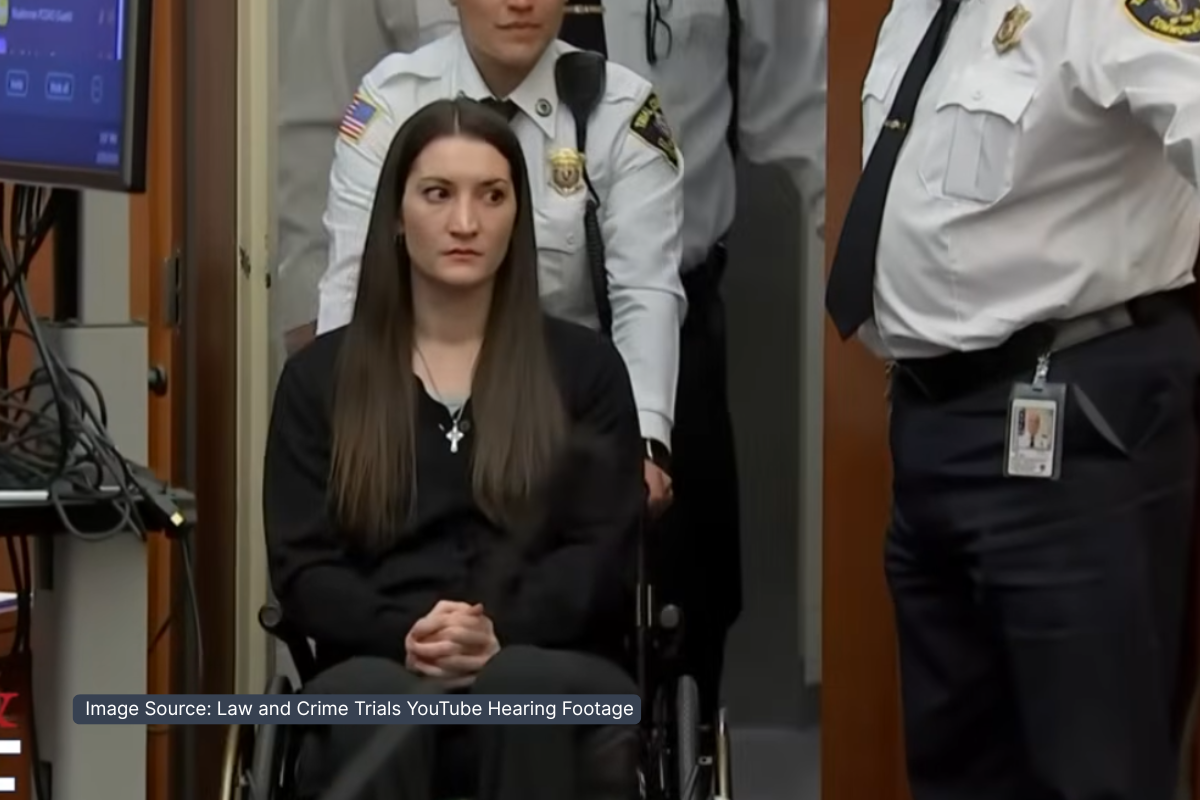
The Lindsay Clancy case sits at one of the most difficult intersections in criminal law: mental illness versus criminal responsibility. It is also where the clean, straightforward narratives offered by both sides begin to break down. The prosecution presents a case built on structure and sequence—creating a window of time, moving deliberately through the home, carrying out a method that required sustained effort, and then taking steps afterward involving communication, movement, and medication.
On its face, that looks like planning. But planning does not automatically equal sanity. A person can follow steps, complete tasks, and appear outwardly composed while still experiencing a distorted or impaired mental state—a distinction that often becomes central in cases involving an insanity defense. Clinical and forensic research recognizes that outwardly organized behavior does not necessarily rule out a distorted mental state, which is why cases involving insanity often turn on internal perception rather than external appearance.
The method of killing further complicates the picture. Ligature strangulation is not instantaneous—it requires time, physical effort, and continuation even after unconsciousness occurs. The prosecution’s argument here is straightforward and powerful: she had multiple opportunities to stop and did not, which supports intent and awareness. The defense, however, is likely to frame this differently—not as a series of conscious decisions, but as an act that, once initiated, continued under a compulsive or dissociative state. This creates a fundamental question for a jury: was this sustained intent, or sustained mental breakdown?
The toxicology evidence presents another layer of complexity, cutting in both directions. For the prosecution, most medications were found at therapeutic or low levels, and the timing suggests the overdose occurred after the killings. Their expert has stated that these medications do not cause psychosis, supporting a narrative of a clear mind first, followed by an overdose. The defense, however, will likely argue that the combination of medications, recent adjustments, and her documented mental distress could have affected her psychological state in ways not fully captured by blood levels alone. “Therapeutic” does not necessarily mean “no psychological impact,” and this is where expert testimony will likely clash most directly.
Even Clancy’s own writings can be interpreted in opposing ways. The prosecution sees organized, logical journal entries that reflect awareness and coherence—evidence of a functioning, rational mind. The defense sees something else: emotional detachment, difficulty bonding, and signs of internal distress. Both interpretations are plausible, which is exactly what makes this evidence so powerful—and so contested.
One of the prosecution’s strongest points is the late emergence of psychosis. There are no documented hallucinations or reports of hearing voices prior to the killings, and the claim appears to surface only after the fact during defense evaluation. That raises credibility concerns. At the same time, the defense may argue that not all patients accurately report symptoms, that some minimize or conceal what they are experiencing, and that psychosis is not always recognized in real time. Even so, this remains a significant hurdle.
The case is further complicated by the absence of a traditional motive. There is no evidence of financial gain, custody disputes, abuse, or outward hostility toward the children. That absence matters. When jurors cannot identify a rational motive, they often look more closely at mental state and internal explanations. The defense will likely lean into this, suggesting that if there is no rational motive, the explanation itself may not be rational.
Ultimately, the case comes down to a single legal question: Did Lindsay Clancy understand what she was doing—and that it was wrong—when she did it? Not whether she was mentally ill—both sides acknowledge she was struggling—and not even whether there was some level of planning. The central issue is whether she was legally responsible at that moment.
This is the kind of case where the facts are deeply disturbing, the law is precise, and the answer is anything but obvious. Because two things can be true at the same time: a person can commit a deliberate act, and still be profoundly mentally unwell. The jury will be asked to determine where that line is—and it will not be an easy decision.
What is Next in this Series?
In the next installment, the focus shifts beyond the criminal case to the growing civil lawsuits, where questions of medical care, diagnosis, and responsibility take center stage.
We’ll also take a deeper dive into the insanity defense itself—breaking down how courts evaluate claims of postpartum mental illness, what it actually takes to meet the legal standard. We’ll take a look at each medication found in Clancy’s system. Central to this case will be a battle of the medical experts.
And finally we’ll take a look at how past cases like Andrea Yates (2001) and Dena Schlosser (2004) succeeded in securing not guilty by reason of insanity verdicts. Because understanding those cases may be key to understanding where this one is headed.
Related Articles
The Lindsay Clancy Tragedy: Murder — or a Mind in Crisis?
Three children are dead. A mother survived. Something unthinkable happened—and the questions that remain have no easy answers. Some cases ask what happened. This one asks how it could have happened...