
Christa Pike Case Updates
On September 30, 2026, Tennessee attempted to execute Christa Gail Pike by lethal injection at Riverbend Maximum Security Institution in Nashville. Despite receiving two administrations of pentobarbital, Pike survived and was subsequently transported to a nearby hospital.
What followed has become an expanding story involving serious medical complications, emergency litigation, an independent investigation ordered by Governor Bill Lee, and the announced resignation of Tennessee Department of Correction Commissioner Frank Strada. This incident has also reignited a long-time debate on the pros and cons of the death penalty in the United States.
This page documents subsequent developments, including statements from Pike’s attorneys, state officials, medical professionals and the family of murder victim Colleen Slemmer.
Visit the CASE DOCUMENTS PAGE for court documents in this case.
October 3, 2026 - Tennessee Corrections Commissioner Frank Strada to Resign Following Failed Execution
Tennessee Corrections Commissioner Frank Strada to Resign Following Failed Execution
Tennessee Governor Bill Lee announced Saturday that Department of Correction Commissioner Frank Strada will step down this month, marking a significant leadership change just three days after Christa Pike’s unsuccessful execution.
Strada, who was appointed commissioner in 2023, maintained that the department had followed its established execution procedures. Nevertheless, he said his departure was in the best interests of Tennessee as the independent investigation moves forward.
The governor’s announcement did not directly attribute Strada’s departure to misconduct or establish responsibility for the failed execution.
An interim commissioner is expected to be appointed while the state conducts its review.
Pike’s condition remains critical, according to the latest information provided by her attorneys. No new hospital-issued prognosis accompanied Saturday’s announcement.
Anesthesiologist Explains Possible Cause of Pike’s Injuries
In an interview published Saturday by PEOPLE, anesthesiologist Dr. Joel Zivot discussed the possible medical explanation for Pike’s injuries following the administration of pentobarbital.
Zivot, who was retained by Pike’s defense team, explained that a failure of intravenous access could have allowed the execution drug to leak into surrounding tissue rather than enter her bloodstream as intended. He suggested that this could account for the substantial burning, swelling and blistering described in the attorneys’ court filing.
The physician also discussed concerns about possible longer-term complications, including neurological or organ injury, depending on what occurred during the procedure and whether adequate oxygenation was maintained. His observations offer a possible explanation for the failed execution, but they should not be interpreted as a confirmed diagnosis or a definitive determination of what happened.
An independent investigation remains pending, and Pike’s treating hospital has not publicly released detailed medical findings.
October 2, 2026 - Attorneys Seek Emergency Protection Against Another Execution Attempt
Attorneys Seek Emergency Protection Against Another Execution Attempt
Pike’s federal public defenders pursued emergency legal relief following the unsuccessful lethal injection, seeking to prevent Tennessee from making another attempt to execute her. The legal action follows the expiration of the September 30 execution warrant and the attorneys’ contention that Pike endured severe and unnecessary suffering during the procedure.
Her legal team has also renewed its request for commutation, asking Governor Lee to replace the death sentence with a prison sentence.
Attorneys Confirm Pike Is Unconscious and on a Ventilator
In a significant medical update Friday, attorneys Stephen Ferrell and Luke Ihnen of Federal Defender Services of Eastern Tennessee disclosed that Pike remained critically ill, unconscious and intubated at a Nashville-area hospital.
According to their statement, she was receiving breathing assistance through a ventilator and undergoing treatment for the serious effects of pentobarbital, including significant injuries to both arms.
The attorneys’ subsequent court filing stated that hospital personnel were working to keep Pike alive while clearing the execution drug from her system. The filing also described Pike’s arms as swollen, burned and blistered upon her arrival at the hospital.
No independent medical prognosis was publicly available, and the hospital had not released a statement describing her expected recovery or the possibility of permanent injury.
Emergency Motion Filed to Preserve Evidence From Execution
Pike’s attorneys filed an emergency motion in Davidson County Chancery Court requesting an order requiring the Tennessee Department of Correction to preserve evidence connected with the September 30 execution attempt. The request covers physical materials, written documentation and electronic records that could help establish what occurred.
According to the attorneys, they previously contacted the state’s legal representatives requesting preservation of the evidence but had not received a response before filing the motion. The filing seeks to protect materials relevant to the execution, anticipated litigation and the investigation into the procedure.
The attorneys contend that preservation is particularly important because complications involving IV placement had been raised in legal proceedings before Pike’s execution date.
Court Filing Raises Questions About IV Placement and Pentobarbital Administration
New details contained in Friday’s court filing suggest that problems establishing intravenous access may have contributed to Pike’s injuries and the failure of the execution. Pike’s attorneys allege that one or more IV lines may have been improperly positioned or that veins may have failed, allowing pentobarbital to enter surrounding tissue rather than circulating normally through her bloodstream.
This complication, known as extravasation, can cause tissue damage depending on the medication involved, its concentration and the amount released outside the vein. The attorneys cited Pike’s swollen, burned and blistered arms as evidence warranting further investigation.
The filing also revisited concerns raised before the execution about Pike’s thrombocytosis and small veins, which her attorneys argued increased the risk of complications during lethal injection. The precise cause of the execution failure has not been independently established.
Questions Raised About When Execution Drug Was Prepared
Additional reporting Friday identified another issue raised by Pike’s legal team: whether the pentobarbital used during the execution had been prepared approximately 12 hours before it was administered.
Pike’s execution was originally scheduled for the morning of September 30 but was delayed by last-minute court proceedings. The attorneys have questioned whether the drug was prepared around the original execution time and subsequently held until the procedure began that evening.
There has been no official confirmation of the preparation time, storage conditions or whether either factor affected the drug’s performance. These questions are among the matters that could potentially be examined during the independent investigation.
Court Grants Expedited Consideration of Evidence-Preservation Request
Following Friday’s emergency filing, a Davidson County Chancery Court granted expedited consideration of Pike’s attorneys’ request to preserve evidence from the execution attempt. The development allows the preservation issue to proceed on an accelerated basis.
Importantly, granting expedited consideration does not constitute a ruling on the underlying motion or a judicial determination that the execution violated Pike’s constitutional rights.
October 1, 2026 - Governor Orders Independent Investigation; Remaining 2026 Execution Halted
Governor Orders Independent Investigation; Remaining 2026 Execution Halted
Tennessee Governor Bill Lee ordered a third-party investigation following the state’s unsuccessful attempt to execute Christa Pike on September 30. Lee also announced that Tennessee’s remaining scheduled execution for 2026 would not proceed this year.
The Tennessee Department of Correction (TDOC) maintained that its execution team followed established protocols. However, the department had not provided a definitive explanation for why Pike survived two administrations of pentobarbital.
Speaking with reporters Thursday, Lee acknowledged that he had few answers about what occurred and said he had no medical update regarding Pike’s condition.
The independent review is expected to examine the circumstances surrounding the execution attempt and why the outcome differed from what the state anticipated.
During a Thursday afternoon virtual press conference, Christa Pike’s a
Attorneys Confirm Pike Is Alive and in Critical Condition
Attorneys confirmed that she remained alive and hospitalized in Nashville following the previous night’s execution attempt.
The attorneys described her condition as critical and said she was receiving life-saving medical care.
Attorney Randy Spivey provided additional details about difficulties establishing intravenous access. According to Spivey, he counted at least seven needles inserted into Pike’s left arm during the procedure, including one that appeared bent when removed.
Spivey also said Pike had cooperated with the execution team and repeatedly suggested alternative locations where they might establish IV access.
The legal team renewed its request that Governor Lee commute Pike’s death sentence, characterizing the prolonged execution attempt as cruel and torturous.
At the time of the press conference, the attorneys had not received a medical prognosis.
Victim’s Mother Responds to Failed Execution
May Martinez, the mother of murder victim Colleen Slemmer, expressed frustration following the unsuccessful execution.
Martinez, who witnessed the proceedings, described the execution as “a mess” during a telephone interview with NBC News. Her comments reflected the distress experienced by family members who had waited decades for the sentence to be carried out, only to leave the prison without the anticipated conclusion.
Slemmer was 19 when she was murdered in Knoxville in January 1995. Pike was subsequently convicted and sentenced to death in 1996.
The failed execution has also renewed attention to the victim’s surviving family and the emotional consequences of the prolonged legal proceedings.
Victim’s Stepfather Calls for Answers
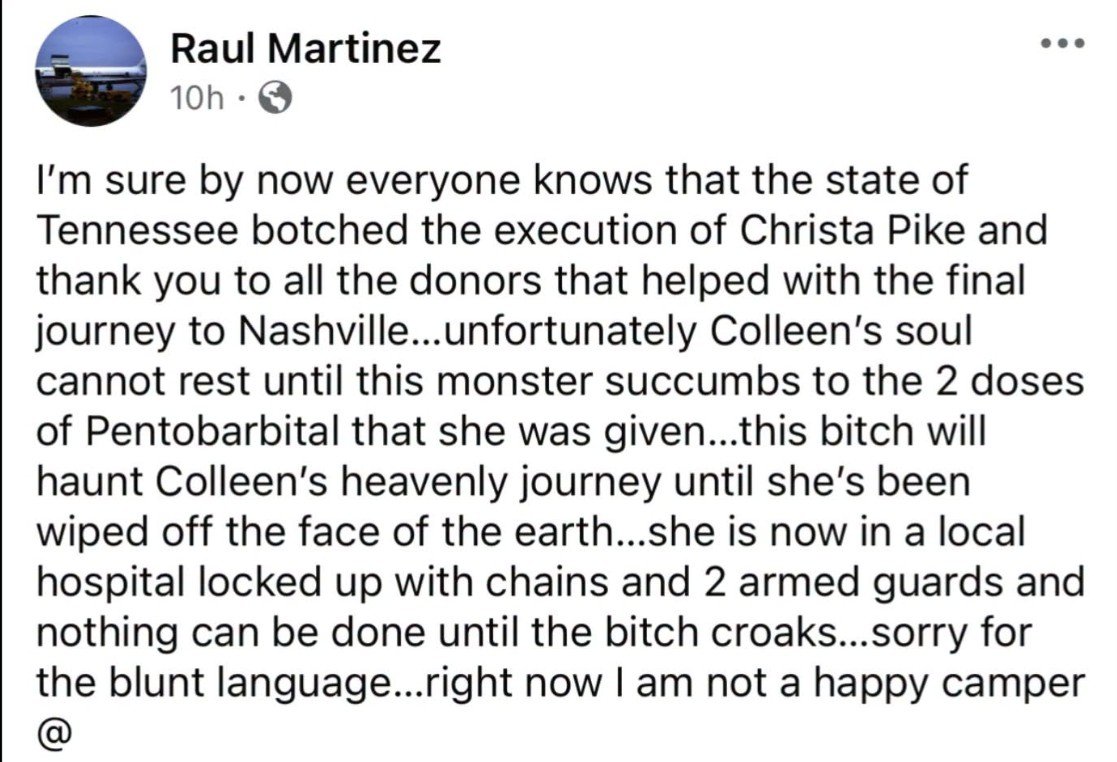 Colleen Slemmer‘s stepfather also spoke publicly following the execution attempt, expressing frustration with the state’s handling of the procedure.
FOX 17 Nashville reported that the family had anticipated Wednesday’s execution would bring an end to a decades-long wait for justice. Instead, they were left with additional uncertainty and questions about what happened inside the execution chamber.
Family members have emphasized that Colleen and the circumstances of her murder should not be lost amid the extensive coverage of Pike’s medical condition and the state’s execution procedures.
Pike’s Attorney Says She Is Unconscious but Not Believed to Be in a Coma
In an October 1 interview with TMZ, one of Pike’s attorneys provided additional information about her hospitalization.
The attorney described Pike as critically ill, unconscious and unable to communicate. However, according to the attorney’s understanding at that time, she was not in a medically defined coma.
The distinction had not been independently confirmed by Pike’s treating hospital. No diagnosis, neurological assessment or prognosis was publicly released.
United Nations Human Rights Chief Condemns Failed Execution
United Nations High Commissioner for Human Rights Volker Türk publicly criticized Tennessee’s failed execution and reiterated concerns about capital punishment and the suffering associated with unsuccessful execution procedures.
The international response added to scrutiny of Tennessee’s lethal injection practices and renewed discussion of whether current execution methods adequately protect against prolonged physical suffering.
The statement followed Governor Lee’s announcement of an independent review and the suspension of the state’s remaining scheduled execution for 2026.
Execution Warrant Expires at Midnight
Pike’s September 30 execution warrant expired at midnight without the sentence being carried out.
The expiration means Tennessee cannot simply resume the original execution under that warrant. Any subsequent attempt would require additional legal proceedings and the establishment of a new execution date.
Pike’s attorneys have indicated that they intend to challenge any further attempt to execute her.
September 30, 2026 - Death Row Inmate Christa Pike Survives Two Rounds of Lethal Injection in Tennessee
Related Articles
No Results Found
The page you requested could not be found. Try refining your search, or use the navigation above to locate the post.