
Former Bryan Kohberger Defense Witness Sy Ray Traded the Courtroom for a Book Tour
Is Sy Ray's Bryan Kohberger cell phone data real? Discover why forensics experts and judges call Ray's methods a "sea of unreliability" as he promotes his self-published book.
The Kohberger Expert Flip
The true-crime community is currently processing a massive ethical whiplash. Sy Ray, the prominent digital forensics expert originally hired by public defender Anne Taylor to save Bryan Kohberger from the death penalty, has completely switched sides.
Bryan Kohberger pleaded guilty last July to the November 2022 slayings of Moscow’s University of Idaho Students Madison Mogen, Kaylee Gonsalvez, Xana Kernodle, and Ethan Chapin. Kohberger has since filed a petition for Post Conviction Relief to reverse his guilty plea.
Now making the rounds on major media circuits, Ray is publicly proclaiming that Kohberger is “100% guilty,” detailing an unreleased “LOCDBOR” cell phone report that allegedly proves Kohberger aggressively stalked victim Madison Mogen for months.
But a closer look at the actual judicial timeline, structural rules of evidence, and Ray’s newly minted commercial ventures reveals a narrative that is far more calculated—and legally toxic—than a sudden burst of civic duty.
The Timeline Mismatch: Sitting on the "Smoking Gun"
The central flaw in Ray’s sudden media revelation is the timeline of his “discovery.” Ray implies that new location data has recently come to light, but the facts show he was sitting on this exact information for years.
➤Late 2023 / Early 2024: Ray’s firm is retained by the Bryan Kohberger defense. He is handed the state’s full discovery packet, which includes the un-mapped, raw AT&T LOCDBOR data file.
➤January 2025: Ray authors and signs an official, binding defense report stating he found “no evidence of association” between Kohberger and the victims.
➤July 2025: Kohberger blindsides the public by entering a guilty plea to avoid execution, legally ending the trial process before Ray ever has to take the stand.
➤Mid-2026: Following Kohberger’s handwritten Post-Conviction Relief (PCR) filing to withdraw his plea, Ray launches a massive media blitz. He brings out the remaining 92% of the LOCDBOR data—which he had possessed since 2024—and claims it proves stalking.
When pressed by journalists on why he hid this incriminating stalking data from his official 2025 court report, Ray claimed he didn’t have to include it because his judicial assignment was strictly limited to dismantling the prosecution’s specific maps.
While Ray claims his 2025 report left out the stalking files because his assignment was strictly limited to responding to the state’s maps, criminal defense procedures reveal a far more calculated reality. As an agent of the defense, Ray was legally barred from disclosing inculpatory evidence to the state.
He authored a report claiming ‘no association’ because that was the only narrative that served his client—proving that his current public outrage over ‘missed evidence’ is a convenient pivot for a mid-2026 book launch, rather than a sudden discovery of new data.
Where Is the Data, and Who Can See It?
With Sy Ray dominating headlines, true-crime advocates and the public are asking a logical question: If this smoking-gun data exists, why can’t we just look at it ourselves? The answer reveals a massive difference between the raw, digital evidence owned by the government and the proprietary, processed maps Sy Ray is keeping behind a commercial paywall.
Sy Ray’s Explicit Gatekeeping
When pushed by journalists and digital forensics peers to release his findings, Ray has explicitly stated that he will not publicly dump his finalized maps or the proprietary code from his software system. Instead, he is expressly using these unreleased visual timelines as the exclusive selling point for his upcoming book, The Truth Line. For the public to see his version of the narrative, they have to buy the book.
The Owners of the Master File
The raw LOCDBOR file is not Sy Ray’s private property—it is an official piece of federal evidence. Because the local Moscow Police Department (MPD) lacked the specialized equipment and federal clearance to extract deep routing logs from AT&T’s corporate legal team, the FBI’s Cellular Analysis Survey Team (CAST) executed the initial “data dump.”
Because it belongs to the master investigative file, the raw text data is currently possessed by:
The Federal Bureau of Investigation (FBI)
The Idaho State Police (ISP)
The Moscow Police Department (MPD)
Latah County Prosecutors
Kohberger’s new Post-Conviction Relief legal team (including Manhattan attorney Jason Goldman)
The Public Access Wall
Even if a journalist filed a Freedom of Information Act (FOIA) request and successfully obtained the raw file, it would be virtually useless to the public. The LOCDBOR report is not a visual map with a red dot tracking Kohberger’s car; it is hundreds of thousands of lines of raw alphanumeric computer code, network pings, timing advance numbers, and cell tower sector IDs.
Because Kohberger entered a guilty plea in July 2025, the case skipped a full trial. Consequently, these raw files were never translated into labeled, visual trial exhibits for the public record. The code remains sealed in police archives, leaving the public entirely dependent on Ray’s un-peer-reviewed interpretation because he is the only actor willing to map the data out-of-court for a commercial true-crime rollout.
The Judicial Reality: "Theatrics and Conspiracy Theories"
Ray’s media campaign relies heavily on the public assuming his scientific findings are ironclad. However, the judicial record shows that the presiding judge in the Idaho case has already formally rejected Ray’s credibility.
During a pretrial evidence motions hearing on April 10, 2025—while Ray was still actively advocating for Kohberger—the defense tried to argue that law enforcement was intentionally deleting data. The prosecution easily disproved this, noting the requested AT&T data simply fell outside a standard 7-day automated retention window.
Judge Steven Hippler completely lost patience with Ray’s assessment, directly castigating the defense’s approach from the bench, calling Ray’s assertions a “conspiracy theory” built on “theatrics with no support.”
The "Sea of Unreliability": Broader Forensic Community Pushback
Judge Hippler is far from the first judicial figure to call out Ray’s methods. The wider digital forensics community has long raised massive red flags over Ray’s proprietary cell-tracking software, ZetX Trax.
In a landmark Colorado District Court ruling, Judge Roberto Villaseñor completely barred Ray’s data from being used in a criminal trial, issuing a scathing evaluation of the expert’s credibility: “Most compelling are the complete absence of data to support Trax’s purported error rate and the scientific community’s wholesale rejection of Trax’s methods.“
Furthermore, Judge Villaseñor noted in his ruling that Ray systematically “inflated his credentials, inaccurately claiming to be an engineer” while testifying to a jury.
Independent forensic investigators have echoed this concern, warning that Ray’s methods create a dangerous “illusion of precision” by turning ambient tower connections into highly specific stalking narratives. Mark Pfoff, a certified computer forensics examiner and former detective, testified directly against the validity of Ray’s software.
Pfoff noted that Trax completely flunks basic scientific admissibility standards and has demonstrated real-world errors—on multiple occasions placing a suspect’s phone at a crime scene when independent vehicle GPS records proved the suspect was miles away on an interstate.
Following the Money: The Book and the Self-Publisher
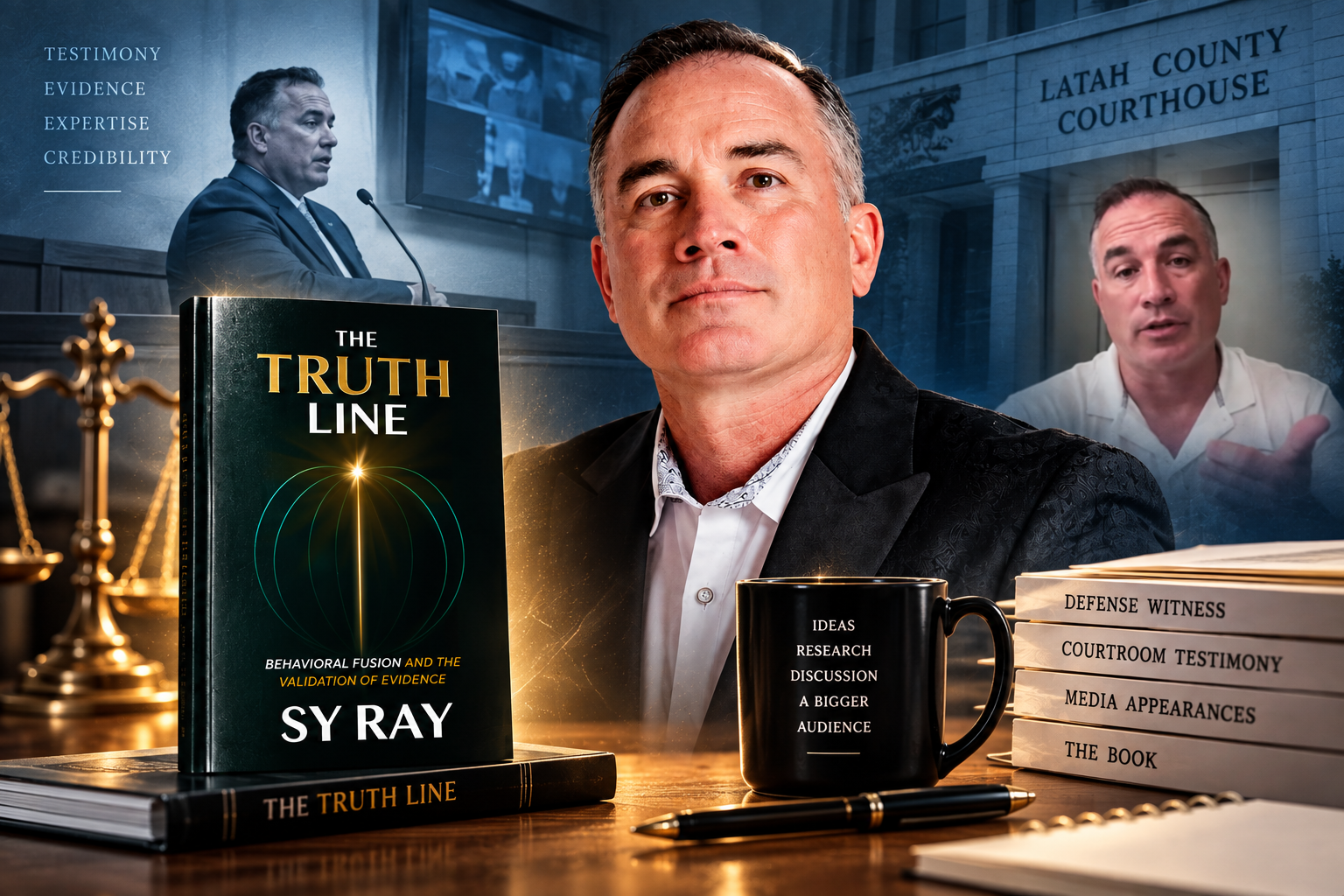
The true motivation behind Ray’s sudden media tour becomes suspect when following the money. Ray is currently aggressively marketing a 577-page book titled The Truth Line: Behavioral Fusion and the Validation of Evidence.
Rather than being vetted by a traditional, objective true-crime publisher, the book is being published directly through Virnous Publishing. Virnous Corporation is a private, for-profit software and training company where Sy Ray happens to be the co-founder.
By launching a sensationalized true-crime press tour using unverified Kohberger data, Ray isn’t just generating personal publicity; he is driving pre-orders to his own company’s publishing wing. Because Ray refuses to release the raw LOCDBOR files to the public or other scientists for independent peer verification, he has essentially locked the “evidence” behind a corporate paywall to serve as marketing material for his company’s software and book roll-out.
The Ultimate Backfire
By running to the media rather than documenting his findings in official 2025 court files, Sy Ray has managed to make himself legally toxic to both sides of the aisle. The defense cannot use him because he is calling their client a monster; the prosecution cannot use him because his entire thesis relies on the idea that the FBI’s initial cellular investigation was sloppy and incompetent.
If Kohberger’s new legal team truly wants to test the validity of Sy Ray’s explosive stalking claims, the solution lies not on the true-crime media circuit, but in the hands of independent global authorities like Cellebrite’s Ian Whiffin.
Whiffin—renowned for his clinical, objective data extractions in high-profile homicide trials—possesses the exact expertise required to peer-review the raw AT&T files. We’ve seen him recently testify at the trials of Karen Read and Lindsay Clancy.
Whether Kohberger’s new defense team, Idaho’s Greg Rauch, and high-profile NY attorney, Jason Goldman, will seek out that level of elite forensic vetting remains to be seen. While Goldman and Rauch are currently fighting the immediate constitutional battle to undo Kohberger’s guilty plea, Goldman has remained entirely silent on whether he would continue to represent the convicted killer if the case resets to a full capital trial—a high-stakes scenario where the death penalty would immediately return to the table.
Ultimately, Sy Ray’s transition from a critical courtroom scientist to a corporate executive promoting a self-published true-crime thriller highlights the slimiest underbelly of high-profile litigation: when the trial ends, the monetizable storytelling begins.
Related Articles
Bryan Kohberger Wants His Guilty Plea Back: What Do the Court Records Actually Show?
Coeur d'Alene, Idaho. – Bryan Kohberger is asking an Idaho court in a Post Conviction Relief filing to withdraw the guilty plea that sent him to prison for life, alleging ineffective assistance of counsel, coercion, false promises, and the withholding of potentially...
Investigators Debunk Myths in Bryan Kohberger Case
Image Credit: (Pool/Getty Images) In a rare and revealing post-sentencing interview with CNN’s Jean Casarez, Idaho State Police Lt. Darren Gilbertson and Moscow Police Chief Anthony Dahlinger addressed the public directly, cutting through a sea of misinformation and...
Will Bryan Kohberger Speak at Sentencing?
Image Credit: (Pool/Getty Images) Update: 7/23/2025 As Predicted, Bryan Kohberger did not make an allocution at his sentencing hearing. Judge Hipler: "Mr. Kohberger, uh, you have an opportunity to make a statement if you wish to. I take it you are declining". Bryan...