
Lindsay Clancy Murder Trial | Day 9 – 10 Psychiatrist Jennifer Tufts Testifies
The Lindsay Clancy murder trial continues with testimony from her first interaction with a mental health provider.
Psychiatrist Dr. Jennifer Tufts Testimony
PLYMOUTH, Mass. – Dr. Jennifer Tufts began treating Lindsay Clancy in September 2022, a little more than four months before Clancy’s three children were killed in their Duxbury home. By the time Tufts saw her for the final time on January 23, 2023 — just one day before the killings — the clinical picture had changed considerably.
What began primarily as anxiety had developed into significant depression. Clancy had struggled with insomnia. She had tried, stopped or declined multiple medications. She had sought treatment from other providers, gone to an emergency department, spent several days hospitalized at McLean Hospital and at times expressed hopelessness and thoughts related to suicide.
But according to Tufts, one thing remained remarkably consistent throughout her treatment of Clancy: she did not observe psychosis or mania, and Clancy repeatedly denied homicidal ideation. That made Tufts an important witness for the prosecution.
Her testimony wasn’t simply about which medications were prescribed and when. It provided the jury with a psychiatric record stretching from September 2022 until approximately 24 hours before Cora, Dawson and Callan Clancy were attacked.
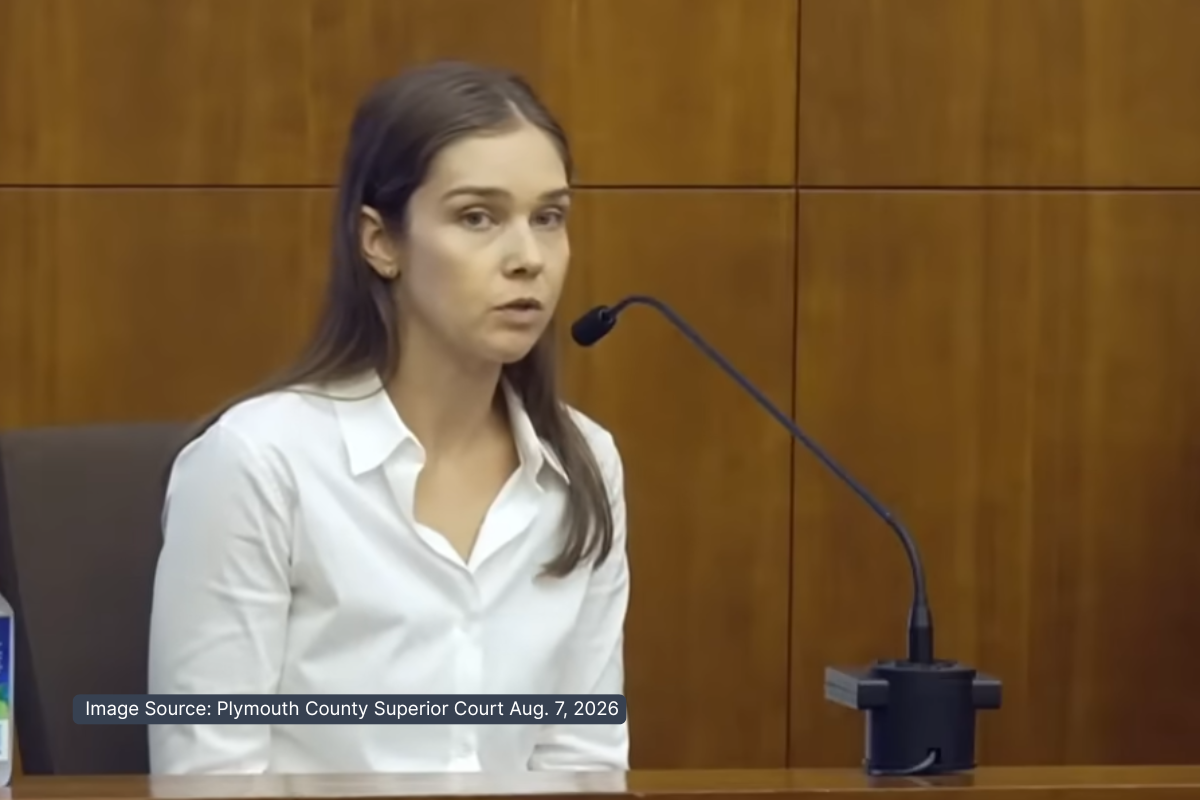
Dr. Jennifer Tufts Direct Examination
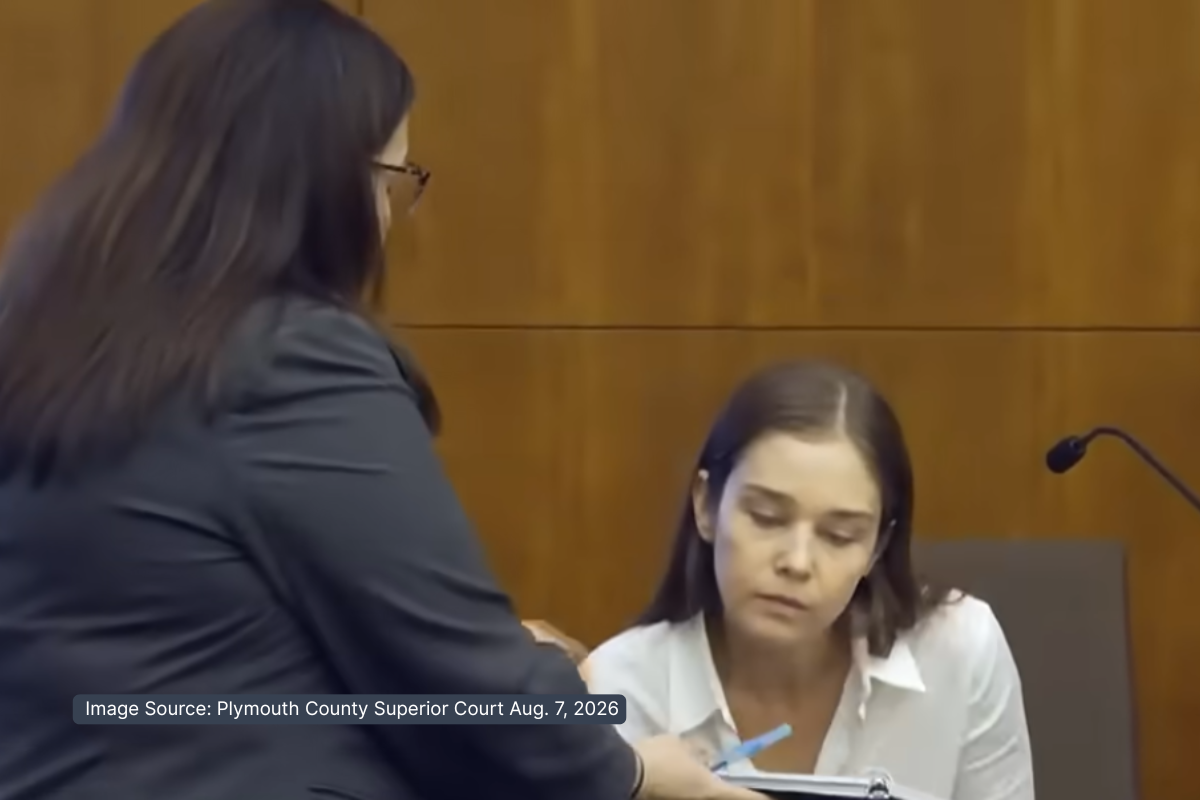
Lindsay Clancy First Sought Treatment for Anxiety
Tufts, a psychiatrist at Aster Mental Health, first evaluated Clancy by telehealth on September 15, 2022. Three days earlier, Clancy had completed extensive intake paperwork describing anxiety attacks, decreased appetite, depressed mood, excessive worry, guilt, difficulty experiencing pleasure, insomnia and racing thoughts. But several symptoms were notably absent.
She did not report excessive energy, risky or impulsive behavior, hopelessness, feelings of emptiness or other symptoms that might have pointed Tufts in a different diagnostic direction.
Clancy also completed a suicide risk assessment. She denied wanting to end her life, having a suicide plan, deliberately hurting herself, hearing voices telling her to hurt herself, having thoughts of killing or seriously harming someone else, or hearing voices telling her to hurt others.
Every answer on the suicide-risk questionnaire was “no.”
When Tufts actually met with Clancy on September 15, she again assessed her for suicidal and homicidal intent, hallucinations, psychosis and symptoms of mania. Clancy denied them. Tufts observed no problems with Clancy’s judgment, insight, orientation, memory, attention or concentration. Clancy described her own mood as “okay,” although Tufts observed that her affect appeared anxious.
Clancy’s primary complaint was anxiety. She described being overwhelmed caring for three young children and particularly anxious about leaving her infant son, Dawson, who would not take a bottle. She worried that if she left him, he wouldn’t eat or sleep. But when specifically asked about it, Clancy denied thoughts of harming the baby.
Tufts diagnosed generalized anxiety disorder and adjustment disorder with depressed mood. She recommended individual therapy and sertraline, better known as Zoloft. Clancy, however, was reluctant to take medication. That reluctance would become a recurring feature of her treatment.
The Medication List Doesn’t Tell the Whole Story
One of the most important things to emerge from Tufts’ testimony was just how misleading a simple list of Clancy’s psychiatric medications can be.
There were a lot of medication names associated with Clancy during the months before the deaths: Zoloft, Ativan, buspirone, hydroxyzine, Prozac, trazodone, Remeron, Klonopin, Seroquel, Valium, Lamictal and amitriptyline, among others.
Read as a list, it sounds extraordinary. Read chronologically, it becomes much more complicated. Clancy did not simply take all of these medications together.
Some were discussed but never prescribed. Some were prescribed but never taken. Some were taken only briefly before being discontinued. Some were used as-needed. Some replaced other medications. And several were prescribed by providers other than Tufts.
Zoloft is a good example. Tufts recommended it at Clancy’s first appointment on September 15. By September 28, Clancy had picked up the prescription but still had not taken it. She wanted to try therapy first.
It wasn’t until approximately mid-October that she finally began taking the medication. Within about a week, Clancy reported feeling “awful.” She described worsening insomnia, decreased appetite, diarrhea, fogginess, tearfulness, anxiety and depression. Tufts told her to stop taking it.
Clancy did not report being suicidal at that appointment. Instead, she expressed fear that if she continued feeling so badly, she might eventually develop suicidal thoughts. The following day, Tufts saw her again because she was struggling with severe anxiety and had not slept. Tufts prescribed a low dose of Ativan on an as-needed basis.
Later, Tufts attempted to move Clancy away from regular benzodiazepine use. Buspirone was prescribed for anxiety, along with hydroxyzine as an as-needed alternative to Ativan. Clancy never started the buspirone because she was afraid to try another medication.
That distinction — between a drug being prescribed and a drug actually being taken — became increasingly important as the medication history grew more complicated.
LINK: Detailed Tufts Lindsay Clancy Psychiatric Treatment & Medication Timeline
Treatment Became Increasingly Fragmented
By late November, Clancy had enrolled at the South Shore Perinatal Mental Health Clinic and planned to transfer her psychiatric care there. But on December 1, she scheduled another appointment with Tufts. She wasn’t getting better.
By then, Clancy had tried several medications and combinations through the South Shore provider. She reported trazodone had little effect. Ativan and Benadryl helped her sleep. Prozac worsened her sleep. Remeron combined with Klonopin left her feeling disoriented and produced rebound anxiety.
She also reported intrusive thoughts while taking Remeron. But the content of those thoughts matters. According to Tufts, Clancy described the thought as:
“I’m going to die.”
Tufts distinguished that from:
“I want to die.”
Clancy said she felt hopeless and close to developing suicidal thoughts, but she denied active suicidal thoughts, intent or a plan. During this appointment, Clancy also made an observation about her own treatment that may be one of the most revealing comments in Tufts’ testimony:
“I think it’s my problem. I keep reaching out to different people and not sticking with the plan.”
Tufts agreed that the situation had become problematic and recommended that Clancy have one person managing her medications.
What About Bipolar Disorder?
December 1 also brought up an issue that has since become central to the defense case: bipolar disorder.
Because Clancy had experienced insomnia and poor reactions to several medications, Tufts specifically considered whether those reactions could indicate bipolar disorder. She concluded they did not. Tufts explained that Clancy did have symptoms of depression, but she did not have the history of mania necessary for a bipolar diagnosis.
She had not demonstrated the sustained euphoria and high energy associated with mania, nor the other symptoms Tufts would expect to see, such as grandiosity, pressured speech, significant risk-taking behavior or a true decreased need for sleep. Insomnia alone, Tufts explained, isn’t the same thing as a decreased need for sleep. A manic person may sleep very little and nevertheless have enormous energy. That was not what Tufts had observed in Clancy.
By December, the Depression Was Getting Worse
By December 16, Clancy’s condition had clearly deteriorated. She told Tufts she was having “a really rough time.” Valium and Seroquel were helping her sleep, but she felt severely depressed during the day and lacked motivation. She had also experienced suicidal ideation.
Clancy had gone to the Massachusetts General Hospital emergency department, where inpatient treatment at McLean Hospital was offered. She declined at that time.
Tufts explored the suicidal thoughts further. According to her testimony, Clancy described feeling hopeless and fearing that she would never recover. But she did not have a suicide plan or intent.
Clancy believed Seroquel was causing her depression. Tufts wasn’t convinced. She had observed depressive symptoms before Clancy began taking Seroquel. Because the depression was becoming more prominent and Clancy had tolerated traditional antidepressants poorly, Tufts prescribed a low dose of Lamictal.
Then, at the end of December, Clancy voluntarily admitted herself to McLean Hospital.
After McLean: Still Depressed, But No Psychosis
Tufts next saw Clancy on January 6, the day after she was discharged from McLean. Clancy told her she had gone into the hospital in part because she wanted to be safely tapered off Seroquel, which she continued to believe was causing her depression. She was now taking trazodone, Ativan and melatonin.
Clancy described herself as feeling “numb.” Tufts believed she remained significantly depressed. But Clancy denied suicidal and homicidal ideation, and Tufts observed no psychosis.
Over the next couple of weeks, the treatment increasingly focused on the depression. Clancy had now been off Seroquel without the depression disappearing, reinforcing Tufts’ belief that the drug itself wasn’t causing the problem.
Ativan was changed to longer-acting Valium because Clancy complained of rebound anxiety and wanted eventually to get off benzodiazepines.
On January 11, Clancy emailed Tufts asking about ketamine therapy. She described herself as very depressed, with little motivation, and said she was becoming “desperate for something that would work quickly.” Tufts believed ketamine might eventually be reasonable if Clancy proved treatment-resistant, but she did not believe they had exhausted the more conventional options yet.
Five days later, Tufts started her on a low dose of amitriptyline. Despite the depression, Clancy was still functioning. She was getting out of bed, maintaining her hygiene, eating, concentrating and caring for Dawson. She told Tufts that bonding with him felt “forced.” She again denied suicidal and homicidal ideation. Tufts again observed no psychosis.
January 23: The Appointment That Stands Out
Then came January 23, 2023. It was Tufts’ final appointment with Lindsay Clancy.
The next evening, prosecutors allege, Clancy strangled her three children with exercise bands before jumping from a second-story window. That timing makes the January 23 mental-status examination particularly significant.
Clancy was not well. She continued to feel flat, numb, anxious and unmotivated. She said she had to force herself to get out of bed and leave the house. But she *was* getting out of bed and leaving the house. She was sleeping. She was appropriately dressed. Her speech was appropriate. Her thought process and thought content were appropriate. Tufts observed no cognitive deficits and no abnormal psychomotor behavior. There had been no deterioration in Clancy’s ability to communicate.
There was no psychosis. Clancy denied suicidal ideation. She denied homicidal ideation.
Tufts slowed the Valium taper because Clancy’s anxiety had increased and increased amitriptyline from 10 mg to 20 mg.
The prosecutor then asked the questions that brought the significance of that final appointment into sharp focus.
Had Clancy told Tufts she intended to kill herself?
“No.”
Had she said she intended to kill her children?
“No, absolutely not.”
Had Tufts observed anything in Clancy’s demeanor, affect or behavior that indicated she was a danger to herself or someone else?
“No.”
Was there anything that would have caused Tufts to seek an involuntary psychiatric evaluation under Massachusetts’ Section 12 law?
“No.”
Approximately 24 hours later, three children were dead.
What the Prosecution Was Establishing:
Tufts’ direct examination was long and at times extraordinarily detailed, but the prosecution appeared to be building several fairly straightforward arguments through her testimony.
Medications Prescribed Do Not Equal the Advised Treatment Plan
The defense has repeatedly emphasized the large number of psychiatric medications associated with Clancy during the months preceding the killings. Tufts’ testimony added critical context. Clancy was reluctant to take medication from the beginning. She sometimes delayed starting prescriptions, sometimes didn’t take them at all and sometimes stopped medications after brief trials because she believed they were causing adverse effects. Other medications were merely discussed. Still others came from different providers.
That doesn’t make the medication history unimportant. Quite the opposite. But understanding it requires more than counting drug names.
Severe Mental Illness Does Not Automatically Mean Psychosis
There is little question from Tufts’ testimony that Clancy’s mental health worsened.
By December and January, Tufts considered her significantly depressed. Clancy described hopelessness, numbness, lack of motivation and difficulty bonding naturally with her baby. At one point she experienced suicidal ideation, and by January she was desperate to find a treatment that worked. But Tufts drew a distinction between severe depression and psychosis.
Throughout her treatment, Tufts continued assessing Clancy’s appearance, speech, thought process, thought content, cognition, behavior and reports of hallucinations. She testified that she did not observe psychosis. She also specifically evaluated Clancy for bipolar disorder and did not believe she met the criteria.
A psychiatrist can only assess the information available.
Another prosecution theme was more subtle but potentially very important.
Tufts explained that psychiatric diagnosis and risk assessment rely partly upon what patients report. That matters enormously in this case. Clancy repeatedly denied homicidal ideation. She denied hallucinations. She did not tell Tufts she was hearing voices commanding her to hurt her children. She did not report a plan to harm them.
If she was experiencing symptoms or thoughts she did not disclose, Tufts could not incorporate information she didn’t have into her assessment. At the same time, that point cuts both ways. The record doesn’t merely contain one denial during one appointment. It contains repeated assessments over months in which Tufts did not observe psychosis and Clancy did not report homicidal ideation.
That leaves the jury with one of the central questions of this case:
What changed — if anything — between the woman Tufts evaluated on January 23 and what happened inside the Clancy home the following evening?
The One Thing That Really Jumps Out
The most striking part of Tufts’ direct examination is not the medication list. It isn’t even the debate over bipolar disorder. It’s January 23.
There is no question from Tufts’ testimony that Lindsay Clancy was psychiatrically ill at that point. She was depressed. She felt numb. Her motivation was poor. She was struggling. But she was not presenting to her psychiatrist as a woman detached from reality.
According to Tufts, she was communicating normally. Her thoughts were organized. Her cognition was intact. She was sleeping. She was functioning. She was caring for her baby. She showed no signs of psychosis. She denied wanting to kill herself and denied wanting to kill anyone else. Nothing Tufts saw gave her reason to believe Clancy needed to be involuntarily hospitalized.
And this wasn’t an evaluation six months before the deaths. It was the day before. That does not tell us what Lindsay Clancy’s mental state was at the moment her children were killed. Tufts could only testify to what she observed and what Clancy reported during their appointments.
But it gives the jury an extraordinarily close clinical snapshot against which the defense’s eventual explanation of Clancy’s mental state will have to be measured.
The cross-examination of Jennifer Tufts would challenge portions of that picture — including the nature of the telehealth treatment, the medication history and the conclusions Tufts drew from her interactions with Clancy.
We’ll look at that testimony next.
Jennifer Tufts — Cross-Examination
Reddington’s overall theory was pretty clear: Tufts was a newly independent psychiatrist, Lindsay was a postpartum patient with increasingly serious symptoms, and Tufts allegedly failed to recognize that Lindsay’s presentation might be more complicated than generalized anxiety and depression.
1. He went hard after Tufts’s experience
Tufts finished her residency at Boston Medical Center in 2022 and began practicing independently at Aster Mental Health in August 2022. Lindsay became her patient approximately a month later, with the first appointment on September 15, 2022.
Reddington repeatedly emphasized that Tufts had only been independently practicing for about a month when she began treating Lindsay. He also challenged the way Aster’s website described Tufts’s interest in women’s/perinatal mental health, essentially suggesting that patients might perceive her as having more postpartum expertise than her independent experience warranted.
Tufts pushed back on that characterization: she had completed four years of psychiatric residency, had treated numerous postpartum patients during residency, and said the website described perinatal psychiatry as an area of interest, not that she advertised herself as an “expert.”
[Editor’s note: The website does, in fact, say the perinatal psychiatry is an area of interest, but also, in another section, it states perinatal Psychiatry under “Areas of Expertise”.]
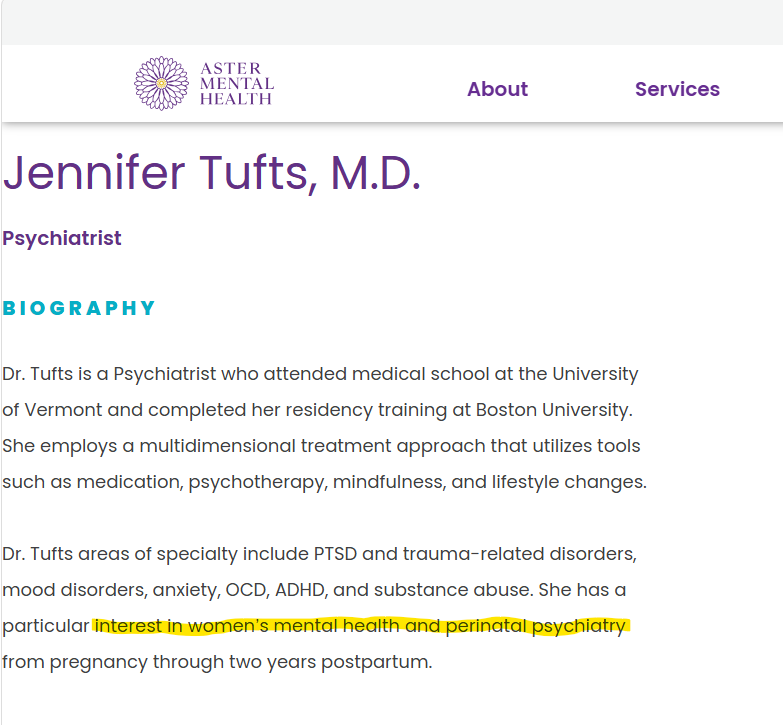
Tufts Aster Website Profile

Tufts Aster Website Profile 2
And, importantly, Reddington brought out that Tufts is a defendant in the Clancy civil lawsuit. That’s an obvious defense avenue for arguing bias or personal stakes in defending the care she provided.
2. Telehealth became a major attack
Reddington spared no time on this argument. All 14 appointments Tufts had with Lindsay were conducted by telehealth. Until Tufts appeared in court, she had never seen Lindsay in person.
Reddington argued that this prevented Tufts from observing things such as hand-wringing, leg movements, agitation and other physical manifestations of distress. Tufts acknowledged the limitations but maintained that she could observe Lindsay on video, speak with her, assess her presentation and knew that Lindsay was experiencing significant distress.
3. Edinburgh vs. PHQ-9
Reddington attacked Tufts for using the PHQ-9 depression screening tool rather than the Edinburgh Postnatal Depression Scale. Tufts said she was familiar with the Edinburgh but did not routinely use it and believed the PHQ-9 was appropriate for assessing depression in a postpartum patient.
Reddington then confronted her with Lindsay’s apparently much higher Edinburgh score obtained elsewhere — something Tufts testified she had not known about.
That matters to the defense theory because they’re trying to show:
The warning signs existed, but the providers treating Lindsay did not have all of the information or did not use the tools that would have revealed the severity of her postpartum symptoms.
Whether the Edinburgh would actually have changed Tufts’s diagnosis or treatment is another question. Reddington was very much arguing the proposition rather than proving it merely by asking it.
4. The earlier Zoloft use after Dawson
After Dawson’s birth, Lindsay had previously taken Zoloft for approximately one week, had some initial side effects and was nervous about breastfeeding. Tufts did not record exactly what those earlier side effects were because she understood them to be ordinary, transient SSRI startup effects rather than anything alarming.
Reddington hammered her over that lack of documentation and argued that this history should have mattered before Tufts prescribed Zoloft again in 2022. Tufts disagreed that anything Lindsay had reported about that earlier trial suggested a dangerous reaction or contraindication.
5. Bipolar disorder / SSRI theory
Reddington began laying the foundation for the defense’s argument that Lindsay may actually have had an underlying bipolar-spectrum disorder rather than merely anxiety/depression, and that prescribing an SSRI could therefore be problematic.
Tufts explained that bipolar disorder involves depressive episodes and episodes of mania. But she rejected Reddington’s suggestion that simply having psychiatric symptoms after a difficult birth meant an SSRI should not have been prescribed because the patient might be bipolar.
It’s clearly setting up the battle we’ll eventually hear from the defense experts:
Prosecution/providers: Lindsay’s presentation was consistent with anxiety/depressive symptoms; there was no evidence of mania or psychosis requiring a bipolar diagnosis.
Defense: Her symptoms and medication reactions were warning signs of an undiagnosed bipolar-spectrum illness, and antidepressant treatment without appropriate mood stabilization worsened her condition.
6. No bloodwork, thyroid testing or pharmacogenetic testing
Reddington also criticized Tufts for not ordering blood testing, including thyroid testing, and questioned her about pharmacogenetic/cytochrome testing.
He brought up literature concerning thyroid function and postpartum psychosis and challenged her familiarity with that research. Tufts acknowledged she had not read the specific study he cited.
But she maintained that Lindsay’s clinical presentation gave her no reason to order thyroid testing, and that the pharmacogenetic testing being discussed would not have provided information that she believed would have changed her treatment. Had she learned Lindsay had abnormal thyroid levels, she said she would have referred her to primary care or endocrinology.
7. Tufts Did Not Obtain Lindsay’s Prior Psychiatric Records
Another significant focus of the defense’s cross-examination was the information Tufts did not have when she evaluated and treated Lindsay.
Tufts did not obtain records concerning Lindsay’s earlier mental-health history, including treatment during college or her postpartum symptoms and treatment following Dawson’s birth. Nor did she independently obtain records from other hospitals or providers involved in Lindsay’s care, including South Shore Hospital.
That gave the defense an important line of attack: How complete could Tufts’s diagnostic assessment have been if she did not review Lindsay’s prior psychiatric history or records from other providers?
This point becomes particularly important given the defense theory that Lindsay’s symptoms were being misidentified as anxiety and depression when they were actually signs of an underlying bipolar-spectrum illness. Prior records potentially could have revealed earlier symptoms, medication reactions, diagnoses or patterns that were not apparent from what Lindsay reported during Tufts’s telehealth appointments.
At the same time, the absence of those records does not establish what they would have shown. The defense can fairly argue that Tufts should have sought additional history; it is a separate question whether those records actually contained evidence that would have changed her diagnosis or treatment.
________________________________________________________
Reddington wasn’t really uncovering a secret second medical history. He was taking the same history and saying:
You were inexperienced. You never saw her in person. You didn’t use the postpartum-specific Edinburgh screen. You didn’t order blood/thyroid testing. You didn’t investigate bipolar disorder sufficiently. You didn’t retrieve other provider records. You prescribed Zoloft despite a prior postpartum Zoloft experience. You didn’t document everything. And now you’re being sued over it.
Tufts’s response, in essence, was:
I was fully trained and licensed; telepsychiatry is legitimate; my diagnoses were based on what Lindsay actually reported and what I observed; the tests you’re proposing weren’t clinically indicated; her earlier Zoloft reaction wasn’t alarming; and the symptoms she reported to me did not demonstrate mania, psychosis, or bipolar disorder.
Jennifer Tufts Finally Stands Up for Herself
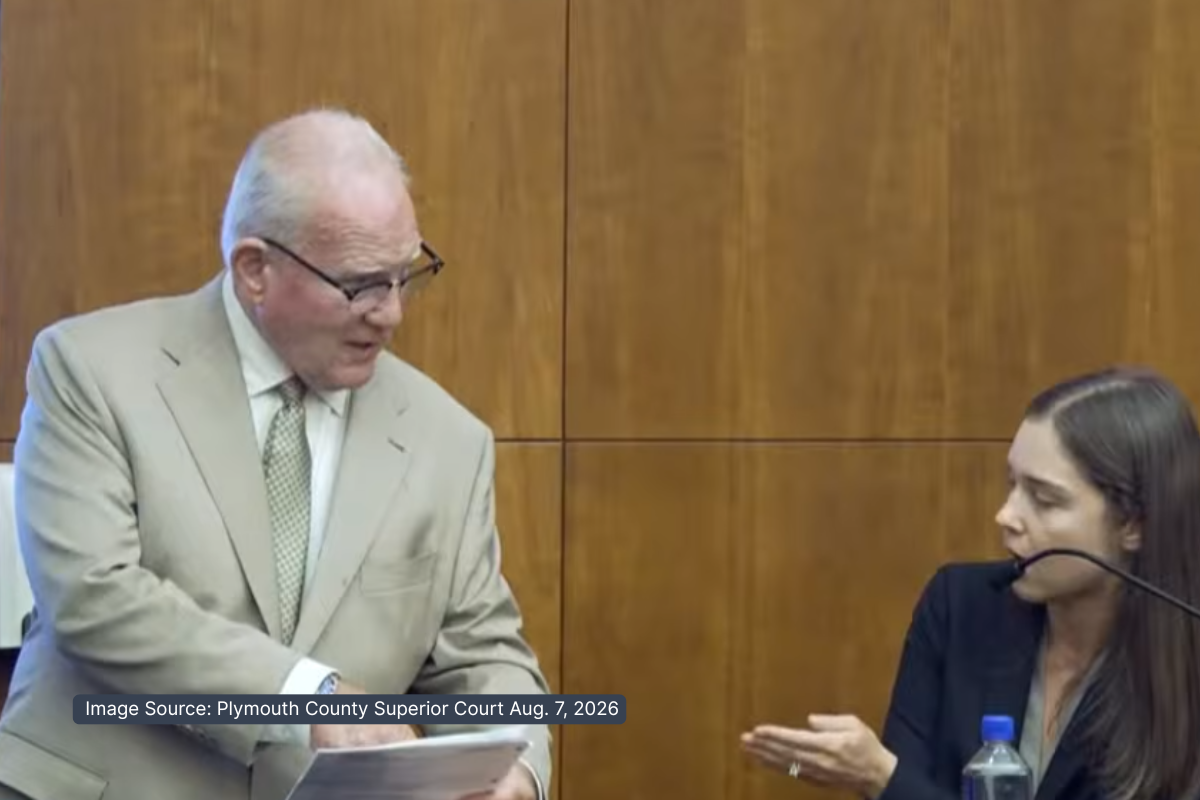
For hours, Dr. Jennifer Tufts had remained remarkably composed under an aggressive and exhaustive cross-examination. She answered questions about her experience, her recordkeeping, telehealth, medications, diagnostic decisions and tests she had not ordered, rarely showing visible irritation.
That changed in the final minutes of her testimony.
Reddington returned to an issue that had become important throughout Tufts’ testimony: pressured speech, a potential symptom of mania. Tufts had repeatedly testified that she had not observed pressured speech in Clancy. Reddington then directed her to an October 21, 2022 note and asked her to read the relevant passage.
Tufts read her shorthand notes, ending with: “Not hyper, pressured speech.”
Reddington immediately zeroed in.
“What was that? Not hyper what?”
Tufts answered that what she meant was “not hyper, not pressured speech.” She acknowledged that the second “not” wasn’t actually written in the note, but insisted there was no ambiguity in her own mind about what she had documented: Clancy did not have pressured speech.
Reddington wasn’t letting it go.
He questioned when Tufts had realized the second “not” wasn’t there. After hours of measured answers, Tufts’ composure finally cracked just enough to reveal her frustration:
“I don’t care what it says. I know what I meant.”
Reddington continued. He argued that the medical record actually said “pressured speech.” He painstakingly parsed the punctuation for the jury: “Not hyper, comma, pressured speech.” Wasn’t that what she had written?
Tufts wasn’t budging.
“She did not have pressured speech.”
Then she told him directly:
“I wrote that, but you’re misinterpreting my note.”
Reddington pressed once more. Hadn’t he read the words correctly?
Tufts conceded that much — but not his conclusion:
“Yes, but your interpretation is incorrect.”
Tufts was visibly irritated. And then the prosecution got redirect.
The prosecutor went directly to another portion of the same October 21 record — the structured mental-status examination. Unlike Tufts’ shorthand narrative note, this section contained specific boxes for describing speech, including options such as “pressured” and “word salad.”
The prosecutor asked Tufts what she had actually checked for Clancy’s speech that day.
“Appropriate.”
And that was essentially the end of it.
The exchange was striking not simply because Tufts became irritated, but because she had shown so little irritation before it. Throughout a lengthy and often confrontational cross-examination, she remained unusually measured, conceding when she did not know something, acknowledging gaps in her records and defending her decisions without becoming combative. The pressured-speech exchange was the rare moment when that restraint visibly slipped.
Whether Reddington’s reading of the shorthand notation initially raised a legitimate question is for the jury to decide. But Tufts was unequivocal about what she meant, and the prosecution had something more substantial than her recollection with which to rehabilitate her: the structured assessment from the same appointment characterized Clancy’s speech as “appropriate,” not pressured.
Analysis: What Did Jennifer Tufts’ Testimony Establish?
Dr. Jennifer Tufts’ testimony gave both sides something to work with, but perhaps not quite what either side would have preferred.
For the prosecution, Tufts provided another treating provider who saw no evidence that Lindsay Clancy was psychotic during the months she treated her. Clancy reported significant anxiety, insomnia, depression and eventually suicidal thoughts, but Tufts did not observe hallucinations, delusions, disorganized thinking or other symptoms that caused her to diagnose psychosis. Her records also documented Clancy’s symptoms as they changed over time, including her responses to medications and the treatment decisions that followed.
The defense, however, exposed legitimate questions about the care Tufts provided. All 14 appointments were conducted by telehealth; Tufts never examined Clancy in person. She did not obtain prior psychiatric or treatment records that might have provided a broader longitudinal picture of Clancy’s mental-health history. The defense also questioned her relatively recent transition from residency to independent practice, her use of the PHQ-9 rather than the Edinburgh Postnatal Depression Scale, the absence of thyroid or other testing, and whether signs of bipolar disorder or hypomania were adequately considered.
But questioning whether Clancy’s psychiatric care could have been better is not the same as establishing that she was psychotic. That distinction may ultimately be one of the most important takeaways from Tufts’s testimony. The defense raised questions about what providers might have missed, while Tufts testified about what Clancy actually reported and what she actually observed during months of treatment.
Ultimately, Tufts was not a perfect witness and her treatment was not beyond criticism. The defense scored points regarding telehealth and the scope of her evaluation. But her testimony also illustrated a problem the defense will eventually have to overcome: it is one thing to argue that Clancy should have been evaluated or treated differently; it is another to prove that the symptoms providers failed to recognize were actually bipolar disorder, mania or psychosis.
That second proposition will require more than hindsight. It will require evidence.
Related Articles
Lindsay Clancy Mistrial – Jurors Speak Out
PLYMOUTH, Mass. – Five jurors have now explained their reasoning after the mistrial. Their interviews reveal how they viewed the evidence, the experts, Lindsay Clancy—and the lone juror who refused to agree. The Lindsay Clancy murder trial ended without a verdict. But...
Lindsay Clancy Murder Trial: Beyond Reasonable Doubt. vs. Reasonable Doubt
Related Articles Related
Lindsay Clancy Jury Deadlock: Did Jurors Understand the Instructions?
PLYMOUTH, Mass. – After days of deliberations and two messages informing Judge William Sullivan that they have been unable to reach a unanimous decision, the twelve jurors deciding the fate of Lindsay Clancy are clearly struggling to agree. But what, exactly, are they...