
Lindsay Clancy Murder Trial: Clancy Toxicology Report vs. Actual Treatment Plan
30 + Prescriptions Filled, 13 Medications Prescribed, yet Clancy was only Authorized Three Medications when she killed her three children.
What Was Lindsay Clancy Actually Supposed to Be Taking? The Toxicology Doesn't Match Her Treatment Plan
PLYMOUTH, Mass. – Much has been made of the number of psychiatric medications prescribed to Lindsay Clancy in the months before the deaths of her three children.
Lists circulated before and during the trial show a dizzying succession of medications: Zoloft, Ativan, Prozac, Remeron, Klonopin, Seroquel, Valium, Lamictal, trazodone, amitriptyline and others. Justice Case Analysis has comprised our own spreadsheet based on the testimony.
But after reviewing the testimony of Clancy’s treating providers alongside the toxicology evidence presented at trial, a different—and potentially much more important—question emerges:
What was Lindsay Clancy actually supposed to be taking on January 24, 2023?
According to the testimony presented thus far, the answer appears remarkably simple.
Amitriptyline and diazepam (Valium) (being tapered to discontinue), and Trazedone, PRN (as needed).
Yet those instructions do not match what toxicologists found in her blood after the deaths of her children. And perhaps just as striking: the medication she had most recently been instructed to take—amitriptyline—has not been identified in the toxicology testimony reviewed to date.
An Important Caveat: This analysis is based primarily on sworn trial testimony, prescription bottles identified in testimony, and toxicology evidence presented to the jury. There may be missing parts, but the information we have so far is clear. Lindsay was authorized to take ONLY ONE medication, another one being tapered, and a third one PRN on that fateful day of January 24th, 2023.
There is also an important distinction throughout this discussion: A medication being prescribed or filled does not necessarily establish that it was taken, and a medication having been prescribed previously does not mean the patient was instructed to continue taking it. We know from testimony that this is the case with Lindsay Clancy. That contrast is at the heart of this issue.
What Prescriptions Medications Was Clancy Authorized to Take on January 23?
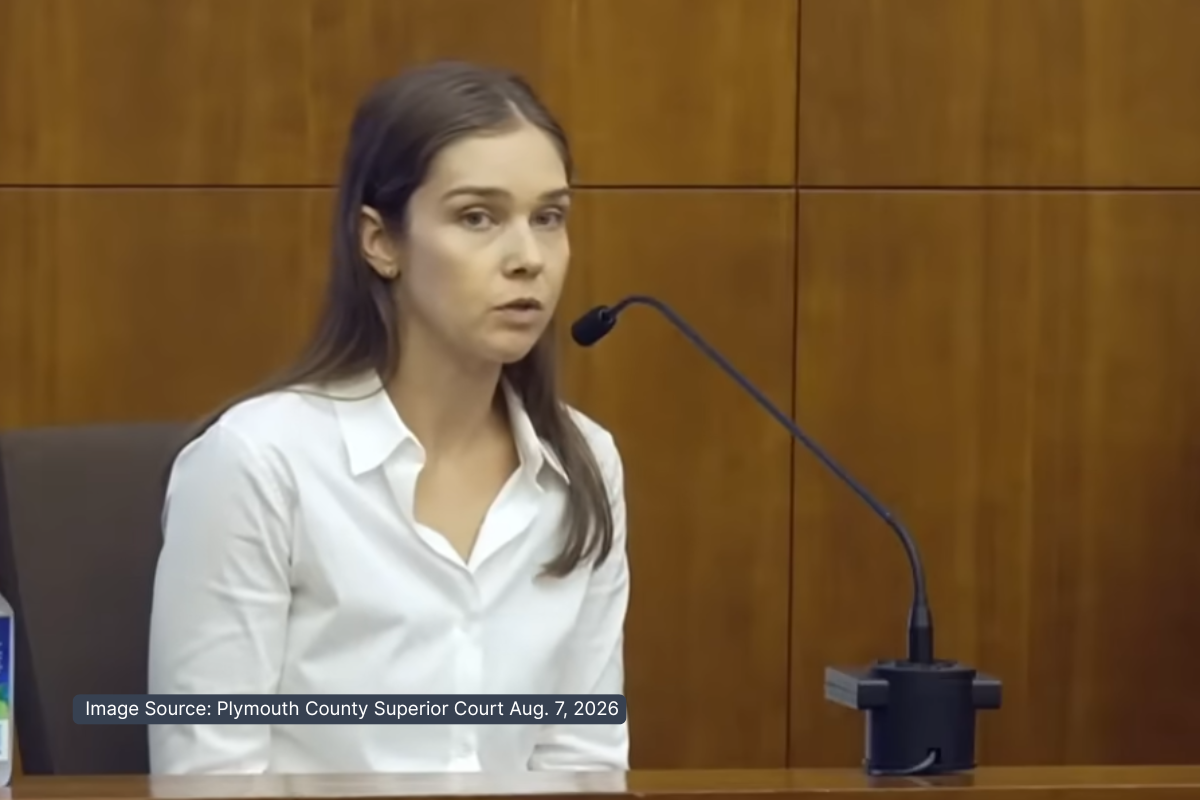
Dr. Jennifer Tufts testified about her final appointment with Lindsay Clancy on January 23, 2023—the day before the children died. By then, Clancy’s medication regimen had been dramatically pared down from the numerous medications that had been tried and discontinued during the preceding months.
amitriptyline 10 mg –> 20 mg. daily, an antidepressant.
diazepam (Valium) taper at 2 mg, a benzodiazepine
Trazedone PRN
Clancy had begun amitriptyline 10 mg daily on January 16 to treat her anxiety and depressive symptoms. At the January 23 appointment, Tufts increased the dose to 20 mg daily. Unlike the other two medications, amitriptyline was intended to be her ongoing daily psychiatric medication, with Tufts continuing to adjust the dose based on Clancy’s response.
Clancy was also continuing a diazepam (Valium) taper at 2 mg. Valium was being used temporarily for anxiety, with the plan to continue reducing and ultimately discontinue the benzodiazepine rather than use it as a long-term daily treatment. The Valium was to help with sleep and anxiety temporarily while the antidepressant took the time to become effective, which takes several weeks.
Finally, Clancy remained authorized to take trazodone as needed (PRN) for sleep. Trazodone had been included in her McLean Hospital discharge plan and was subsequently renewed by Tufts. It was not intended as her primary daily antidepressant treatment in this regimen, but as a PRN sleep medication.
According to Tufts’ testimony, Clancy denied suicidal or homicidal thoughts and showed no indication of psychosis during that final appointment.
So despite the lengthy lists of psychiatric prescriptions that have circulated publicly, the treatment plan immediately before January 24 was not a simultaneous regimen of eight, ten or thirteen psychiatric medications. Based on the testimony reviewed to date, it was amitriptyline, tapering Valium, and as-needed trazodone.
Medications Prescribed Do Not Equal the Approved Treatment Plan
What Toxicology Found
After the incident on January 24, Clancy’s blood and urine underwent toxicology testing by the Massachusetts State Police Crime Laboratory and additional quantitative testing by NMS Laboratories.
The results tell a very different story. Lindsay Clancy Toxicology Results
On trial Day 7 the first two witnesses matter quite a bit for the medication timeline.
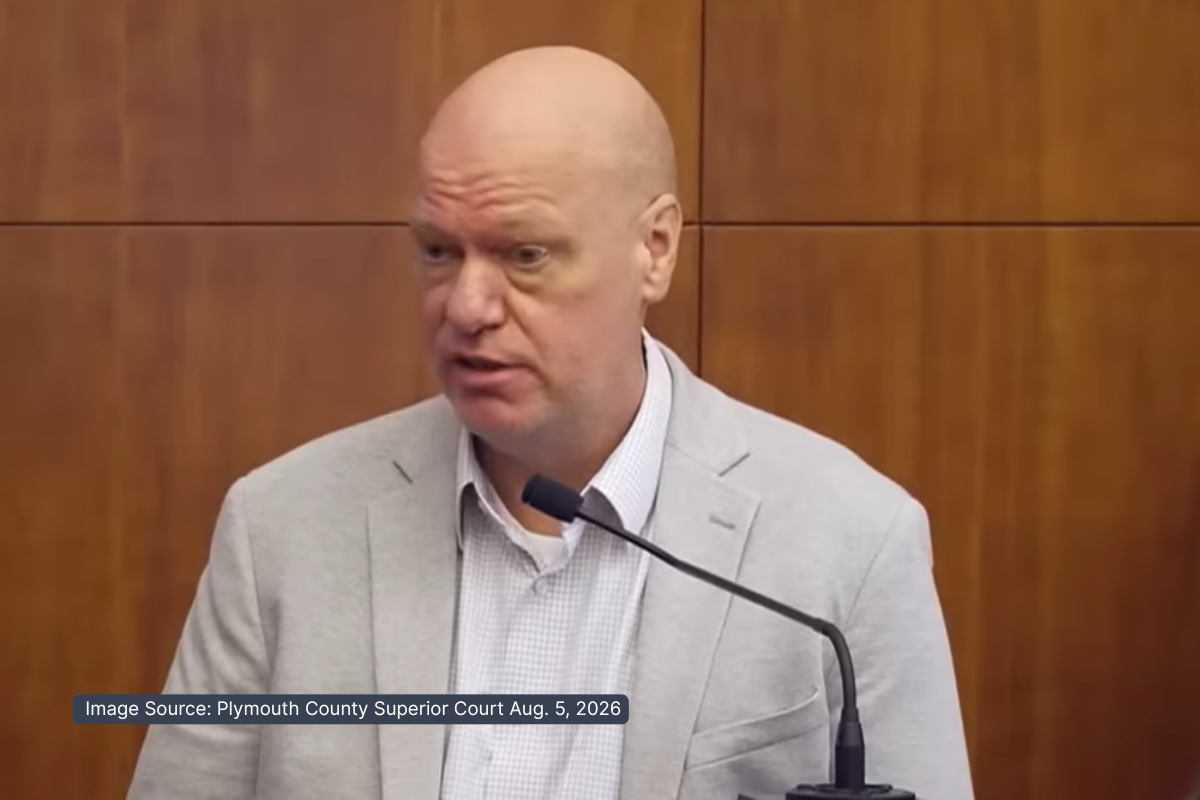
The first is Nicholas Roberts, formerly of the Massachusetts State Police Crime Lab toxicology unit. The second is Dr. Justin Brower, forensic toxicologist with NMS Laboratories. Together, they establish what was actually detected in Lindsay Clancy’s blood and why some of it had to be sent to an outside lab for quantification.
Roberts confirms that what sounds initially like five different benzodiazepines does not necessarily mean five separate benzodiazepine medications. Diazepam can metabolize into nordiazepam, temazepam, and oxazepam. Lorazepam, however, is separate. That distinction is going to be important when we reconcile the toxicology with the prescription history.
Then Brower gives us the actual NMS concentrations for the four drugs specifically requested by the Plymouth DA.
Massachusetts State Police forensic scientist Sarah Griffiths performed the confirmatory testing of Clancy’s urine and the quantitative testing of benzodiazepines in her blood. Griffiths explained that the multiple benzodiazepine-related substances listed in the results did not necessarily represent multiple drugs taken. Diazepam (Valium) breaks down in the body into nordiazepam, oxazepam and temazepam, all of which were detected. Lorazepam (Ativan) was also detected. Her testing provided the actual measured concentrations of the benzodiazepines found in Clancy’s blood.
Former Massachusetts State Police forensic scientist Lisa Yelle performed the broader “general unknown screen” of Clancy’s blood and urine, a test capable of screening for hundreds of prescription medications and drugs of abuse. Her testing detected several psychiatric medications, including mirtazapine, lamotrigine, trazodone and quetiapine, as well as drug metabolites. Yelle emphasized that this screening test establishes only whether a substance was detected or not detected; it does not determine how much was present.
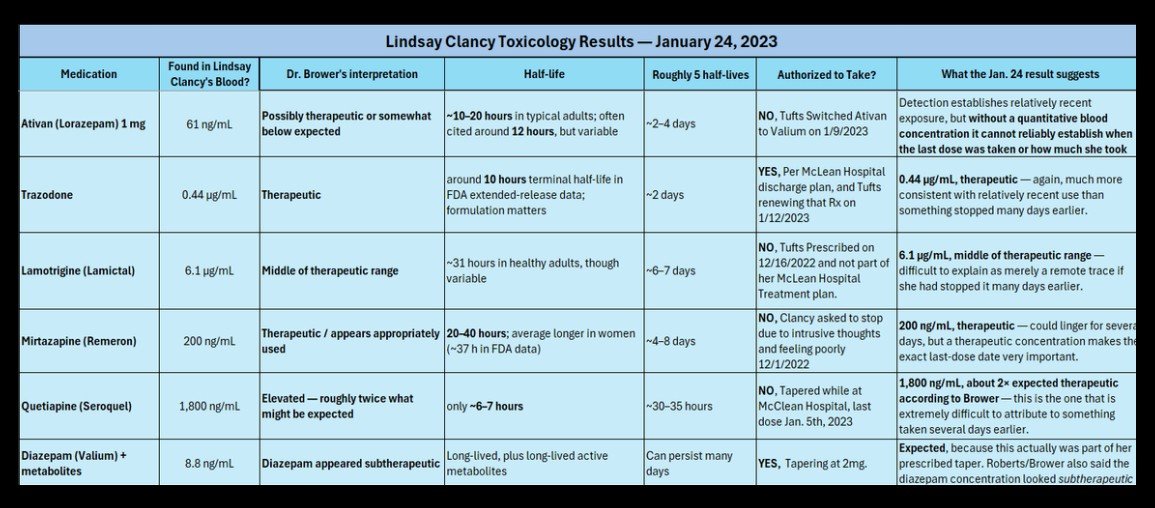
Testing identified:
* Diazepam (Valium) and its metabolites
* Lorazepam (Ativan)
* Lamotrigine (Lamictal)
* Mirtazapine (Remeron)
* Quetiapine (Seroquel)
* Trazodone
Several benzodiazepines initially appearing in the laboratory results were explained as metabolites—breakdown products—of diazepam and therefore do not necessarily represent separate medications.
Lorazepam, however, is a separate drug.
NMS Laboratories then quantified four of the other medications, their blood concentrations, and the toxicologist’s testimony:
| Lamotrigine (Lamictal) | 6.1 µg/mL | Middle of therapeutic range |
| Mirtazapine (Remeron) | 200 ng/mL | Therapeutic / consistent with appropriate use if prescribed |
| Quetiapine (Seroquel) | 1,800 ng/mL | Elevated, approximately twice what might ordinarily be expected |
| Trazodone | 0.44 µg/mL | Therapeutic |
The diazepam concentration appeared subtherapeutic, while the lorazepam concentration could have been therapeutic or somewhat below the expected level depending upon dose.
That creates an obvious discrepancy.
With the exception of Valium and trazedone, the medications detected in Clancy’s blood do not appear to match the medication plan described by Tufts for January 23.
Seroquel Raises an Especially Important Question
Quetiapine may be the most difficult result to reconcile with the treatment history. Clancy had been taking Seroquel before her January admission to McLean Hospital. During that hospitalization, physicians tapered her from the medication. By January 5, Seroquel had been discontinued.
Seroquel (quetiapine) has a relatively short elimination half-life of approximately six to seven hours. A drug’s “half-life” is the amount of time it takes for the amount of drug in the body to decrease by half. After approximately five half-lives — about 30 to 35 hours for quetiapine — roughly 97% of the original amount has been eliminated.
That timing is significant in this case. If Clancy’s last dose of Seroquel had actually been January 5, approximately 19 days had passed before her blood and urine were collected on January 24. Yet toxicology testing detected both quetiapine and a quetiapine metabolite in her blood and urine. The toxicology screening did not establish the amount present, and the precise detection window depends upon the laboratory method used; therefore, the results alone cannot establish exactly when or how much Seroquel Clancy took. They do, however, raise an important question about whether January 5 was actually her final dose.
Yet approximately 19 days later, Clancy’s blood contained 1,800 ng/mL of quetiapine. NMS forensic toxicologist Dr. Justin Brower testified that the concentration appeared to be approximately twice what he might ordinarily expect therapeutically. Importantly, however, he did not characterize it as a lethal concentration or as evidence of an attempted Seroquel overdose.
Brower explained that in suicide cases involving quetiapine, he might see concentrations approaching approximately 10,000 ng/mL, often after someone consumed handfuls of pills. He specifically testified that Clancy’s result was not consistent with that scenario.
Nevertheless, the presence of an elevated concentration of a medication that had been discontinued weeks earlier raises an obvious question:
When did Clancy take the Seroquel found in her blood, and why?
The toxicology testimony presented so far does not answer that question.
Other Discontinued Medications Were Present at Therapeutic Levels
Seroquel wasn’t alone. Brower characterized Clancy’s Lamictal level as being in the middle of the therapeutic range. According to testimony, this was prescribed on December 16, 2022, and should have been discontinued, if she ever started taking it, while at McLean Hospital.
Her Remeron level appeared therapeutic. Likewise, the Mirtazapine was prescribed on November 28, 2022, and allegedly discontinued on December 1, 2022.
Her trazodone level was therapeutic.
Yet none of those medications was part of Tufts’ January 23 treatment plan.
A historical prescription list tells us what medications were prescribed or dispensed over a period of months. Toxicology tells us what was actually present in Clancy’s body. And provider testimony tells us what she was actually being instructed to take at a particular point in treatment. Those are three different things.
Where Was the Amitriptyline?
There is another question that deserves attention.
Amitriptyline was the antidepressant Tufts prescribed on January 16. Clancy reportedly was taking 10 mg, and Tufts instructed her to increase the medication to 20 mg on January 23. Yet amitriptyline has not been identified among the substances discussed in the toxicology testimony reviewed for this article.
That does not yet establish that amitriptyline was absent from Clancy’s blood. The State Police laboratory performed several types of screening, and NMS Laboratories was subsequently asked to conduct direct quantitative testing for only four specifically requested medications: lamotrigine, mirtazapine, quetiapine and trazodone. Until the complete toxicology documentation is reviewed, it would be premature to conclude that Clancy had not taken amitriptyline.
But based upon the testimony presented thus far, the question remains:
Was the medication Clancy was actually instructed to take present in her system?
A Prescription List Is Not a Medication Regimen
This may be one of the most important distinctions to emerge from the trial. Widely circulated lists showing every psychiatric prescription Clancy filled over several months can create the impression that she was taking all—or many—of those medications simultaneously.
The trial testimony does not support such a simple interpretation. In fact, during Patrick Clancy’s testimony, prosecutors themselves emphasized this distinction.
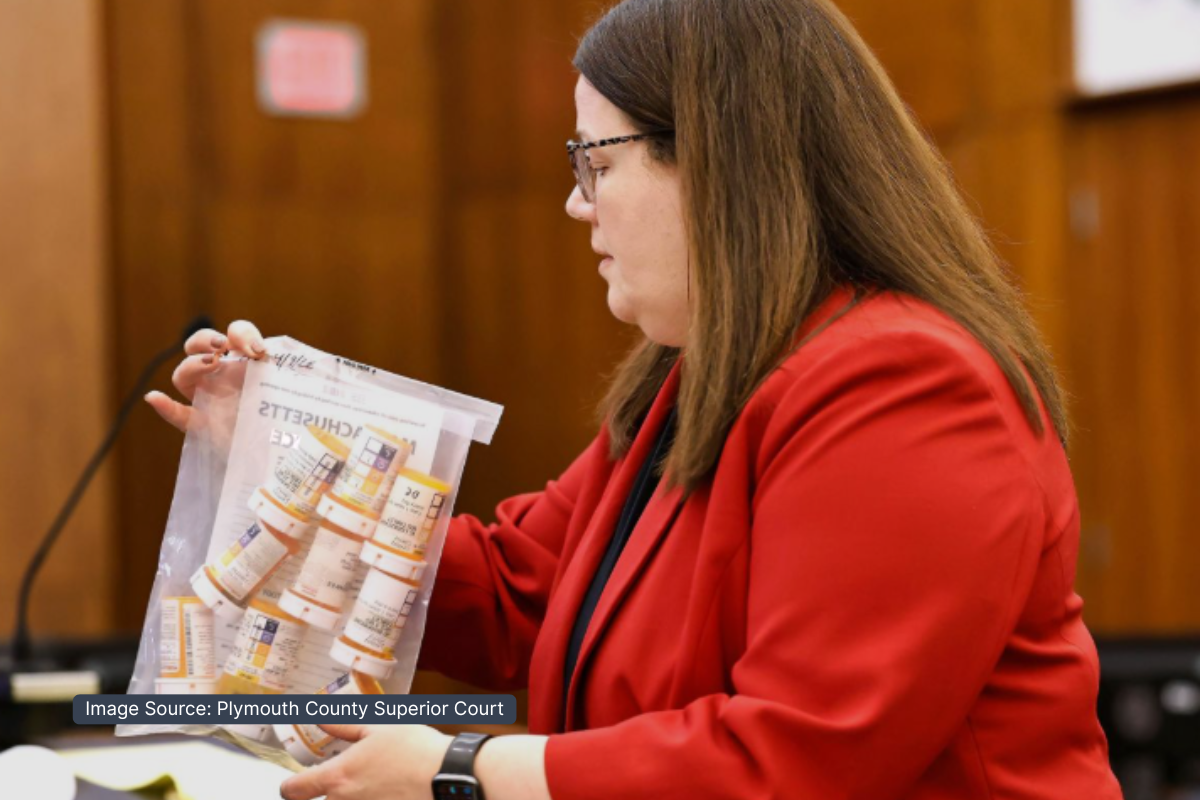
Patrick acknowledged that many pills remained in prescription bottles turned over to police. The Commonwealth specifically questioned him about the difference between the large number of prescriptions written over several months and the smaller number of medications Clancy was actually prescribed at any particular time.
That distinction is critical when evaluating claims that Clancy was “overmedicated.” It appears she was overmedicated, not by irresponsible providers, but by Clancy herself.
There is no question that her psychiatric treatment involved frequent medication changes, at her own request due to complaints about side effects. Drugs were started, stopped, increased, decreased and replaced, sometimes after only days. Whether that rapidly changing treatment contributed to her psychiatric condition is ultimately a medical question and is central to the competing theories being presented at trial.
But it is not accurate to treat every prescription written between September and January as though Clancy had been instructed to take all of those medications together.
The Toxicology Did Not Show a Massive Pill Overdose
Another significant point emerged from Brower’s testimony. Despite the number of medications detected, he did not identify the concentrations as demonstrating a suicide attempt by massive medication ingestion.
Seroquel—the most elevated of the four medications quantified by NMS—was still well below the concentrations Brower said he commonly encounters in quetiapine overdose deaths.
The remaining NMS-tested drugs were characterized as therapeutic. That is notable because Clancy unquestionably had access to numerous prescription medications. The evidence presented thus far indicates that her suicide attempt involved severe physical injuries, including cuts to her wrists and neck and a jump from a second-story window.
Whatever explains the additional medications in her bloodstream, the toxicology testimony so far does not establish that she attempted to end her life by swallowing a massive quantity of those pills.
Questions That Still Need Answers
There are several pieces of evidence that could significantly clarify this picture.
The complete CVS prescription and dispensing history is particularly important. It was entered into evidence, and displayed on a screen, but the entire list was not visible, and the presentation was not accompanied by testimony to name the list. A publicly circulated list identifies numerous fill dates and prescribers, including January diazepam fills attributed to more than one provider: both psychiatrist Jennifer Tufts, and NP Rebecca Jollotta.
Those entries need to be reconciled with the providers’ sworn testimony and the actual pharmacy records before conclusions can be drawn about when those prescriptions were written, filled, or intended to be used. Jollotta testified that Clancy’s last visit to that clinic was around December 20th. But according to the circulating list, prescriptions were filled for Valium allegedly ordered by Jollotta in late January. According to the Treatment plan, Valium was to be tapered, and Lindsay asked Tufts that the Valium taper be slowed and extended on January 23rd.
The complete toxicology documentation is also needed to determine whether amitriptyline was specifically tested, if so, whether it was detected.
Finally, medication bottles recovered from different locations in the Clancy home—and additional bottles later provided to law enforcement—need to be reconciled with prescription dates, quantities dispensed, quantities remaining and the provider testimony. Testimony listed the bottles and fill dates of the bag of medications Patrick Clancy turned in, but there is no testimony that detailed the medications in the kitchen cabinet nor the bedside table.
What We DO Know
By January 23, Lindsay Clancy was not being instructed to take every psychiatric medication that had been prescribed to her during the previous four months.
According to the treatment testimony reviewed thus far, her active plan was amitriptyline, trazedone prn, and a tapering dose of Valium.
The following day, toxicology detected Valium along with several previously prescribed psychiatric medications that were not part of that treatment plan.
Some were present at therapeutic concentrations. Seroquel was present at an elevated concentration despite having been discontinued weeks earlier. And the toxicology testimony reviewed thus far has not identified amitriptyline—the medication she had most recently been instructed to take.
None of this, standing alone, tells us why those medications were present or what effect, if any, they had on Clancy’s mental state on January 24. It does establish something much more basic:
The list of medications Lindsay Clancy had been prescribed is not the same thing as the medications she was instructed to take—and neither list perfectly matches what toxicologists actually found in her body.
That discrepancy far more attention as the trial continues.
Related Articles
Lindsay Clancy Mistrial – Jurors Speak Out
PLYMOUTH, Mass. – Five jurors have now explained their reasoning after the mistrial. Their interviews reveal how they viewed the evidence, the experts, Lindsay Clancy—and the lone juror who refused to agree. The Lindsay Clancy murder trial ended without a verdict. But...
Lindsay Clancy Murder Trial: Beyond Reasonable Doubt. vs. Reasonable Doubt
Related Articles Related
Lindsay Clancy Jury Deadlock: Did Jurors Understand the Instructions?
PLYMOUTH, Mass. – After days of deliberations and two messages informing Judge William Sullivan that they have been unable to reach a unanimous decision, the twelve jurors deciding the fate of Lindsay Clancy are clearly struggling to agree. But what, exactly, are they...