
David (d4vd) Anthony Burke Preliminary Hearing Day 3
A factual recap of Day 3 of David Anthony Burke's (d4vd) preliminary hearing, including key testimony, evidence presented, and the prosecution and defense arguments.
What Was Presented on Day Three
Courtroom Drama
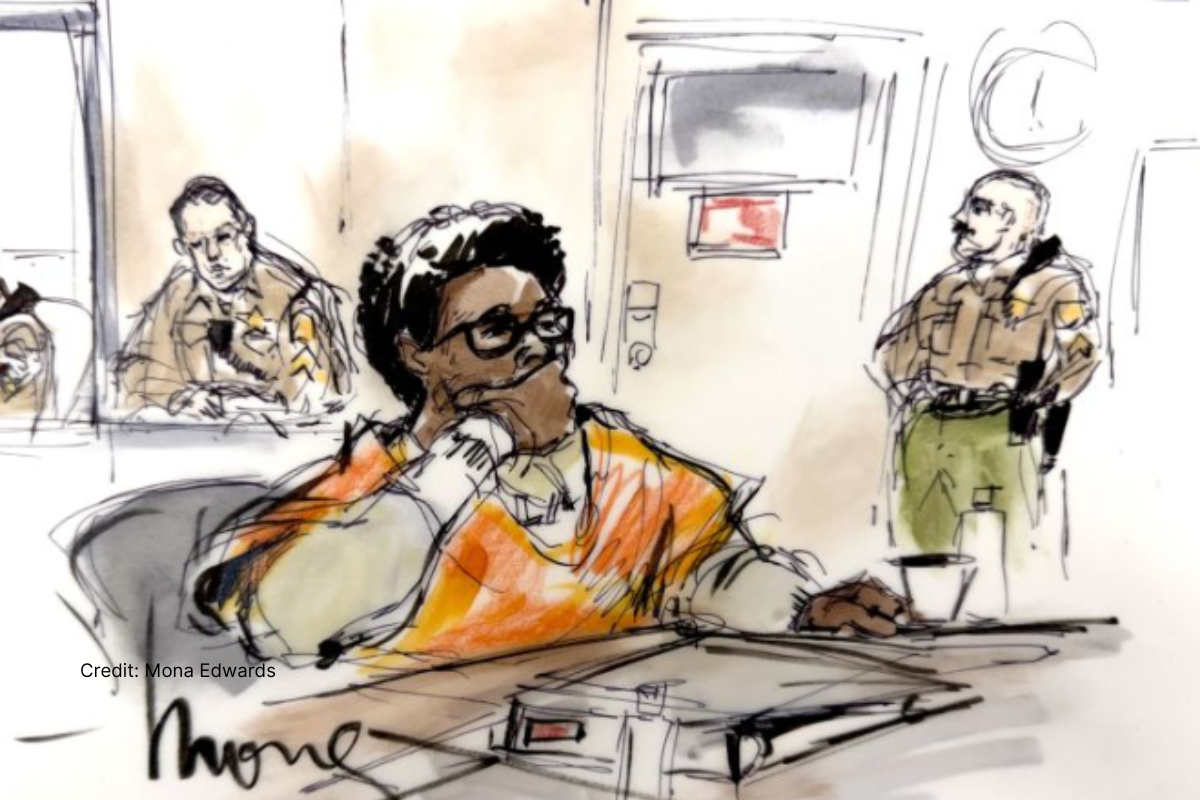
Before testimony resumed, Judge Olmedo dealt with an unusual disruption after learning a reporter had violated the court’s prohibition on live reporting from inside the courtroom. According to discussions in open court, the reporter had been updating a live Google document during testimony. The judge ordered the reporter removed from the courtroom for the remainder of the day and revoked laptop privileges, reminding everyone that the rules applied equally to all members of the media. Security procedures were also tightened as the hearing continued.
Before testimony resumed, Prosecutor Beth Silverman informed the court that private investigator Steve Fischer, who had previously testified before the grand jury in this case, was present in the courtroom. She argued that, as a grand jury witness, Fischer should not remain in the courtroom during testimony. Silverman also alleged Fischer had engaged in inappropriate interaction with attorney Patrick Steinfeld, who represents Celeste Rivas-Hernandez’s family.
Steinfeld disputed that characterization, telling the court that he had approached Fischer—not the other way around. The judge ultimately directed Fischer to leave the courtroom in accordance with the grand jury witness rule, and Fischer complied without incident.
Fischer is a licensed private investigator hired by the owner of Burke’s rental property following Celeste’s disappearance. He has become a well-known public commentator on the case through interviews with media outlets and legal analysis programs. Fischer has also been involved in a separate dispute with prosecutors stemming from his public discussion of matters related to the grand jury proceedings, making his presence in the courtroom notable.
Fischer commented after the hearing that “What happened in the hallway really kind of shocked me.” He further explained that Beth Silverman was upset that Celeste Rivas Hernandez’s family attorney spoke to Fischer outside the courtroom, and that Silverman had previously been unhappy that Fischer spoke publicly about the case after the grand jury proceedings.
While the incidents briefly interrupted proceedings, testimony quickly returned to the evidence in the case.
Lauren Wallace – LAPD criminalist – cross-examined by Berk
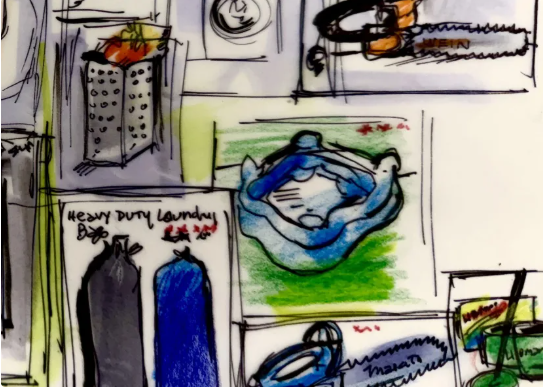
- Wallace testified investigators did not swab the chainsaw handles for touch DNA because presumptive blood testing on the blades was negative.
- A third handheld electric saw found in a closet was not collected because investigators determined it had no forensic value.
- Wallace observed containers of fake blood in the garage, tested them, found no evidentiary value, and they were not collected.
- She was never instructed to search the second floor where the boxed burn cage was reportedly located.
- On redirect, prosecutors emphasized investigators only collect evidence believed to have forensic value, not every object in a home.
In her cross examination, Berk suggests investigators overlooked potentially important evidence and failed to conduct a complete investigation.
The prosecution on redirect pointed out that investigators followed normal forensic procedures and were selective—not negligent—in what they collected.
Lisa Lahendro – LAPD Criminalist who specializes in trace evidence analysis.
From the inflatable pool, she identified using a stereo microscope:
hairs
fibers
plant material
possible foam-like flakes
Lahendro also documented four distinct areas of damage to the pool, describing a combination of straight and irregular cuts, some of which penetrated completely through the material.
Examination of Celeste’s clothing, which was wet and covered in dirt and insects:
Sketchers socks
Victoria’s Secret thong
Forever 21 tube top, heavily soiled, that may have originally been yellow
Black leggings that appeared to have been cut in half, in which blue plastic fragments were recovered
Lahendro presented what may have been some of the most compelling forensic testimony of the preliminary hearing. She testified that blue plastic fragments recovered from Celeste’s remains were compared with damage found on a blue plastic kiddie pool recovered from Burke’s garage. The fragments physically matched the missing portions of the pool, fitting together “like puzzle pieces.”
She also described numerous comparisons of trace evidence linking items recovered during the investigation.
This testimony is designed to physically connect Burke’s garage to Celeste’s remains. Unlike circumstantial timeline evidence, the matching plastic fragments create a direct forensic link between an item recovered from Burke’s residence and injuries found on Celeste’s body. This was arguably one of the strongest pieces of physical evidence presented thus far.
The defense questioned the certainty of the comparisons and explored possible contamination or transfer issues. However, there appeared to be little room to challenge the physical “puzzle piece” match itself, instead focusing on whether the evidence could establish how or when the fragments became associated with the body.
LAPD Detective William Roecker, Robbery-Homicide Division – specializes in cellular records analysis
Roecker analyzed David Anthony Burke’s cellphone and another tied to Burke’s Tesla’s IMSI, or International Mobile Subscriber Identity, including David Burke’s cell phone location data. This witness walked the court through Burke’s cell phone records and historical cell-site analysis.
His testimony showed Burke’s phone traveling north toward Santa Barbara multiple times during the period investigators believe Celeste disappeared. He also discussed calls placed between Burke’s phone and Celeste’s phone after investigators believe she was already deceased, with those calls going unanswered. Investigators also mapped the phone’s movements near locations where evidence was later recovered, including the area where Celeste’s passport card was found.
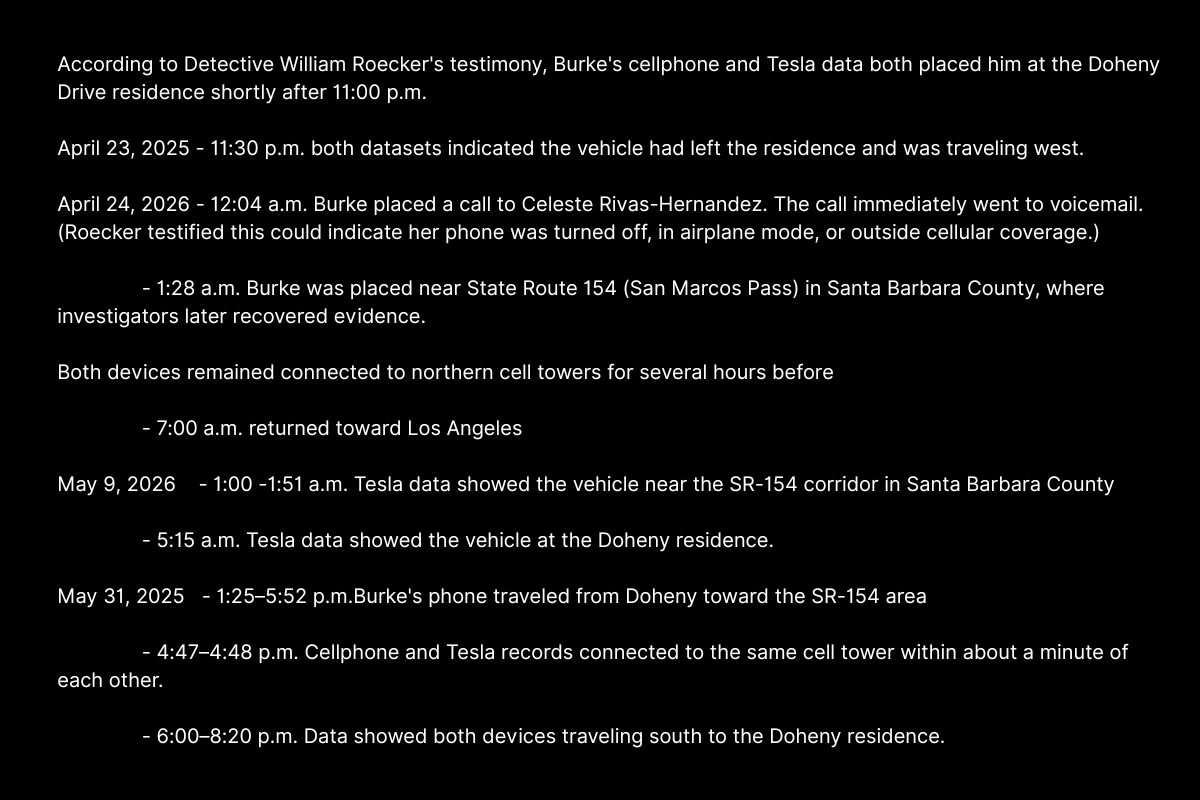
Wrapping up his direct testimony, Detective William Roecker testified that investigators relied on surveillance footage, automated license plate reader data, and Tesla records to establish the vehicle’s final known movements. Based on those sources, he concluded Burke’s Tesla was not driven after approximately 2:00 p.m. on July 29, 2025, until investigators recovered it on September 5, 2025. Roecker’s findings supported earlier testimony about when the vehicle was last used.
The prosecution is using the phone evidence to establish Burke’s movements during the critical time period and corroborate the timeline developed through surveillance footage and physical evidence. Rather than relying on one piece of evidence, prosecutors are attempting to show that Burke’s phone consistently traveled along the same routes investigators believe were used to transport and dispose of Celeste’s remains.
Upon cross-examination, Defense attorney Marilyn Bednarski emphasized the limitations of historical cell-site analysis. Through cross-examination, Bednarski established that:
Cell towers cannot pinpoint an exact location.
Phone records cannot identify who was actually holding the phone.
The records cannot establish whether Burke was alone.
The technology cannot prove exactly where someone stood.
The defense attempted to show that while the records suggest general travel patterns, they do not definitively place Burke at any specific crime scene.
LAPD Criminalist Samantha Tosch – DNA Analyst
LAPD criminalist Samantha Tosch testified that she developed a full DNA profile from a toenail sample collected during Celeste Rivas Hernandez’s autopsy, along with a reference DNA profile from a buccal (cheek) swab provided by David Burke.
Tosch testified that DNA analysis linked Celeste to multiple items recovered during the investigation. DNA consistent with Celeste was identified on:
a black rubber floor mat in Burke’s garage
a rowing machine
the Tesla charging plug
a green tarp
bloodstains recovered from the Tesla cargo area
additional stains collected during the investigation
Most of the DNA profiles produced exceptionally strong statistical matches, with Tosch testifying they were approximately one septillion times more likely to have originated from Celeste than from an unrelated individual. Although the DNA recovered from the black rubber garage mat produced only a partial profile due to the limited amount of genetic material, she testified that 15 genetic markers matched Celeste’s DNA, making it approximately 20 quadrillion times more likely to have come from Celeste than from another person.
Tosch also testified about two black trash bags recovered during the investigation. One contained a mixed DNA profile from four contributors, including Burke, while Celeste was excluded as a contributor. A separate trash bag containing hand wipes with brown stains produced a single-source female DNA profile consistent with Celeste, and Burke was excluded as the contributor.
The testimony built upon earlier BlueStar testing presented during previous hearing days by confirming that several presumptive bloodstains were associated with Celeste through DNA analysis.
What the Prosecution Is Trying to Establish
Prosecutors used the DNA evidence to argue that Celeste’s biological material was present throughout Burke’s garage and Tesla, linking her directly to locations under his control. Combined with the trace evidence, vehicle data, and cell phone records presented throughout the preliminary hearing, the DNA evidence strengthens the prosecution’s theory that Celeste was inside Burke’s garage and vehicle before her remains were transported to Santa Barbara County.
Defense Cross-Examination
Defense attorney Blair Berk focused on both the scientific limitations of DNA testing and the way the analysis was presented to the court.
During cross-examination, Berk established that Tosch served as the technical reviewer for the DNA testing rather than the primary analyst who performed every test, although Tosch testified that she contributed to the final report. Berk also confirmed that prosecutors had reviewed the expected areas of testimony with Tosch before she took the stand so she could familiarize herself with the reports.
Berk then emphasized the limitations of DNA evidence, establishing that DNA testing cannot determine:
when DNA was deposited
how it was deposited
what activity caused the DNA to be transferred
whether the DNA originated from blood or another biological source, such as skin cells
Tosch agreed that DNA can remain on an object for weeks, months, or even years, and that laboratory testing cannot distinguish between DNA left through direct contact and DNA transferred indirectly. She acknowledged she could not determine how or when Celeste’s DNA came to be on the rowing machine, tarp, garage mat, Tesla charger, or other tested items.
Berk also questioned the mixed DNA profile recovered from one trash bag, noting that STRmix software statistically estimated possible contributors. While Burke was included as a contributor, Tosch agreed it was fair to describe him as a possible contributor rather than a definitive one. Berk further suggested that multiple people may have had access to Burke’s garage, a characterization Tosch acknowledged was fair.
Redirect Examination
On redirect, Prosecutor Beth Silverman clarified that while DNA testing cannot determine how genetic material was deposited, analysts only report a DNA association when the profile is scientifically consistent with the individual being identified. Tosch agreed that the samples reported as matching Celeste were consistent with her DNA profile.
Dr. Grant Ho, the deputy medical examiner with the Los Angeles County Medical Examiner’s Office.
The final witness called on Day 3 was Dr. Grant Ho, a deputy medical examiner with the Los Angeles County Medical Examiner’s Office. Because court adjourned before his testimony concluded, the majority of his testimony continued into Day 4.
Dr. Ho testified that he has worked for the Medical Examiner’s Office for approximately five years, has performed more than 2,500 autopsies, and has testified in court about 40 times.
Ho told the court he performed the autopsy on the remains identified through dental records as 14-year-old Celeste Rivas Hernandez. He testified that Celeste was approximately 5 feet 2 inches tall and weighed 71 pounds at the time of her death.
The medical examiner described the remains as “markedly decomposed,” explaining that the advanced state of decomposition significantly limited portions of the examination. Despite those limitations, he documented traumatic injuries consistent with the dismemberment of the extremities and noted that Celeste was still wearing her orthodontic braces when her remains were examined.
What the prosecution is trying to establish
Dr. Ho’s testimony began laying the medical foundation for the prosecution’s case by documenting the condition of Celeste’s remains and introducing the forensic findings that would become a major focus of testimony on Day 4.
Defense
Cross-examination had not yet begun before court recessed for the day. Dr. Ho’s testimony resumed when proceedings continued on Day 4.
Prosecution Strengths
Day 3 may have been the prosecution’s strongest day of the preliminary hearing.
Major strengths included:
Physical trace evidence connecting the kiddie pool in Burke’s garage to Celeste’s remains.
DNA confirmation linking Celeste to multiple locations inside Burke’s garage and Tesla.
Continued digital evidence reinforcing Burke’s movements during the relevant time period.
Multiple independent forensic disciplines—digital evidence, trace evidence, and DNA—all supporting the same overall timeline.
Rather than relying on a single “smoking gun,” prosecutors continued layering independent pieces of evidence that reinforce one another.
Defense Strengths
The defense maintained its strategy of emphasizing the limitations of forensic evidence.
Key themes included:
Cell phone records cannot pinpoint an exact location.
Historical cell-site data cannot identify who possessed the phone.
DNA cannot establish when or how it was deposited.
Forensic evidence cannot identify the person responsible for Celeste’s death.
Rather than attempting to dispute every scientific finding, the defense focused on reminding the court that each piece of evidence has limitations when viewed in isolation.
My Assessment After Day Three
The prosecution’s case has grown substantially stronger over the first three days of testimony.
The evidence presented thus far paints an increasingly compelling picture that Celeste’s body was dismembered, transported, and disposed of using locations and items connected to David Burke. The combination of surveillance evidence, digital data, trace evidence, DNA, and witness testimony creates a powerful circumstantial case supporting that theory.
However, an important legal question still remains: Has the prosecution proven Burke killed Celeste?
At this stage, the evidence appears much stronger on post-mortem conduct—transporting, dismembering, concealing, and disposing of the body—than it does on the actual act of homicide.
As of Day 3, the hearing testimony does not identify direct evidence establishing:
how Celeste died
where she was killed
who inflicted the fatal injuries
or an eyewitness to the killing
That does not mean the prosecution cannot prove murder. Under California law, juries frequently convict on entirely circumstantial evidence when the individual pieces collectively point to one reasonable conclusion.
The prosecution appears to be constructing exactly that kind of case: each witness adds another piece to a larger puzzle rather than providing a single definitive answer.
The defense, meanwhile, is expected to argue that while the evidence may strongly suggest Burke participated in concealing or disposing of Celeste’s remains, it does not necessarily eliminate every reasonable possibility regarding who actually caused her death.
Whether prosecutors can bridge that gap will likely depend on testimony still to come, particularly from the medical examiner and any additional forensic experts.
Related Articles
Celeste Rivas Hernandez Family Sues d4vd: What the 20-Page Lawsuit Actually Alleges
LOS ANGELES - The family of Celeste Rivas Hernandez has opened a second legal front against singer David Anthony Burke, better known as D4vd. Celeste's parents, Mercedes Martinez and Jesus Edgardo Rivas Alvarado, have filed a sweeping 20-page civil complaint in Los...
David Anthony Burke (d4vd) Preliminary Hearing Day 5: Judge Orders Singer to Stand Trial
Courtroom Drama The fifth and final day of David Burke's preliminary hearing shifted from introducing new evidence to bringing together the digital, forensic, and witness testimony presented over the...
David (d4vd) Anthony Burke Preliminary Hearing Day 4
Courtroom Atmosphere Day 4 focused primarily on forensic pathology and digital evidence. The morning was dominated by testimony from the Los Angeles County Medical Examiner, who detailed the autopsy...